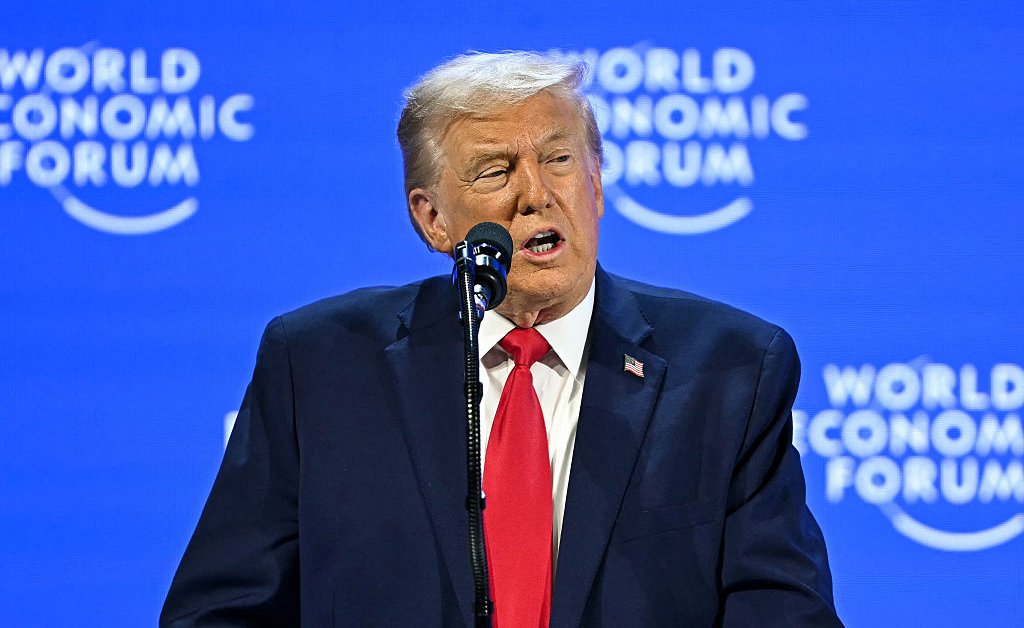
President Donald Trump delivered a defiant and combative address at the World Economic Forum on Wednesday, using the annual gathering of world leaders and business executives to tout America’s role as the world’s main peacekeeper and economic engine, and make his most explicit case yet for the U.S. to acquire Greenland from Denmark.
Calling for “immediate negotiations” with Denmark, Trump asserted that Greenland was essential to American and global security, even as he insisted he would not use military force to obtain it—his clearest effort yet to somewhat soften the threat behind a demand that has already unsettled NATO allies.
“We probably won’t get anything unless I decide to use excessive strength and force, where we would be, frankly, unstoppable,” Trump said. “But I won’t do that.”
He added: “I don’t have to use force. I don’t want to use force. I won’t use force. All the United States is asking for is a place called Greenland.” Yet the President made clear that he still envisioned full American ownership of the semiautonomous Danish territory, arguing that “you need the ownership to defend it” and that “you can’t defend it on a lease.”
“This enormous unsecured Island is actually part of North America, on the northern frontier of the Western Hemisphere,” Trump said. “That’s our territory.”
The comments underscored Trump’s willingness to wield raw power and transactional threats in pursuit of territorial and strategic gains—even at the risk of tearing at alliances that have anchored Western security since World War II.
While Trump insisted he did not intend to use force, he coupled that assurance with a thinly veiled warning: “You can say yes and we will be very appreciative, or you can say no, and we will remember.” That combination of conciliation and coercion came up repeatedly throughout Trump’s remarks. He boasted of forcing NATO members to increase defense spending, even as he questioned whether they would come to America’s aid if the United States were attacked. He described Europe as dependent on American protection but insufficiently grateful for it. “The problem with NATO is that we’ll be there for them 100%,” he said. “But I’m not sure that they’d be there for us.”
Read more: The Most Startling Line From Trump’s Davos Speech
Trump’s speech, which lasted more than an hour, emphasized how dramatically his maximalist foreign policy has shifted the footing of those attending the annual World Economic Forum. Once a bastion of multilateralism and consensus-building, the forum this week revolved around a single question: how to navigate a world increasingly shaped by one leader’s willingness to pressure allies as aggressively as rivals.
Trump began his remarks focused on delivering a triumphant verdict on his first year back in office, calling it “the fastest and most dramatic economic turnaround in our country’s history” and claiming inflation had been “defeated,” the border rendered “virtually impenetrable” and growth set to surpass any previous benchmark. He contrasted his record with what he described as the “nightmare of stagflation” under former President Joe Biden whom he repeatedly derided as “the autopen.”
But what unfolded over the course of his lengthy speech was less a celebration of economic revival than a sweeping assertion of American dominance—and of his own role as its chief architect—over allies, adversaries and institutions alike.
“The USA is the economic engine of the planet,” Trump declared. “And when America booms, the entire world booms.”
“Without us, right now you’d all be speaking German and a little Japanese, perhaps,” Trump said to the room full of billionaires, government officials, and diplomats.
Trump warned that “certain places in Europe are not even recognizable anymore,” blaming “unchecked mass migration,” environmental policies, and the outsourcing of heavy industry for what he called the continent’s decline. He criticized Europe multiple times, even as many of its leaders sat in the audience.
“The more windmills a country has,” he said, “the more money that country loses.”
He urged other nations to “follow what we’re doing” while making clear that noncompliance would carry costs. He boasted of slashing regulations and cutting tariffs on domestic producers while raising them on foreign goods, and he claimed to have reduced the U.S. trade deficit dramatically while securing deals covering 40% of American trade.
The message resonated uneasily in Europe, where leaders have spent the past year struggling to navigate a more transactional and confrontational Washington. Emergency summits, retaliatory tariff planning, and quiet efforts to insulate European industries from American pressure have become a staple of the diplomatic calendar since Trump returned to office.
Nowhere was that tension clearer than when Trump turned to Greenland. “No nation or group of nations is in any position to be able to secure Greenland other than the United States,” he said, recounting how American forces defended the island during World War II before returning it to Denmark, a decision he now questioned. “How ungrateful are they now?” he added. At various points, Trump appeared to confuse Greenland with Iceland. “Iceland has already cost us a lot of money,” he said, a reference to the stock market’s recent dip. By the end of his address, the U.S. stock market had risen following his assurances that no military action would be used to acquire Greenland.
The comments came amid a growing rift with Denmark and other European governments, which have rejected any suggestion that the island could be sold or transferred. In recent weeks, Denmark has increased its military presence in Greenland, joined by Germany, Sweden and Norway.
The President’s posture stood in sharp contrast to the thinly veiled condemnations of U.S. policy delivered on Tuesday in Davos by key European figures. Prime Minister Mark Carney of Canada warned of a “rupture” in the world order, declaring that the rules-based international system was eroding and that “the strong do what they can, and the weak suffer what they must.” French President Emmanuel Macron decried the use of coercion and tariffs to advance territorial ambitions, asserting that Europe would not accept the “law of the strongest” or be intimidated by “bullies.”
Trump responded to their comments by singling out both leaders. He mocked Macron’s sunglasses before recounting how he said he forced France’s leader to narrow the gap between French and American drug prices by threatening sweeping tariffs. “Emmanuel, you’re going to do it, and you’re going to do it fast,” Trump said he told the French leader, recalling a threat to impose a 25% tariff on French goods and a 100% tariff on French wine and champagne if he did not comply. French officials have previously disputed aspects of his account.
“Canada gets a lot of freebies from us,” Trump said, adding that it “should be grateful” to the United States. Referring directly to Carney’s appearance at Davos, he said, “I watched your Prime Minister yesterday. He wasn’t so grateful.”
“Canada lives because of the United States,” Trump added. “Remember that, Mark, the next time you make your statements.”
The episodes served as a broader illustration of Trump’s approach to diplomacy: not as a matter of quiet negotiation among allies, but as a series of public confrontations in which leverage is applied through the blunt use of American economic power.
At Davos, such remarks landed with particular force. Halfway through the speech, a senior Western European official told TIME: “We can’t react to everything he says. We have our values and our interests, and we have to work with the U.S. to protect them. We have to talk. We listen; then we talk.”
Trump’s speech also revisited long-standing grievances and disputed claims: that his 2020 election loss was “rigged,” that he had single-handedly settled eight wars in the past year, and that the war in Ukraine would never have happened had he remained in office.
He touted a deal with Venezuela over oil production, took credit for wiping out Iran’s nuclear program, praised the expansion of U.S. nuclear and artificial intelligence infrastructure, and spoke admiringly of allowing private companies to build their own power plants. Throughout, Trump returned to a central theme: that American power, unapologetically wielded, was the ultimate guarantor of global stability.
“We did a lot of big things, all perfectly executed,” Trump said.
—With reporting by Nikhil Kumar/DAVOS
Uncategorized,Davos 2026,Donald TrumpDavos 2026,Donald Trump#Territory #Trump #Davos #Speech #Push #Greenland1769070935