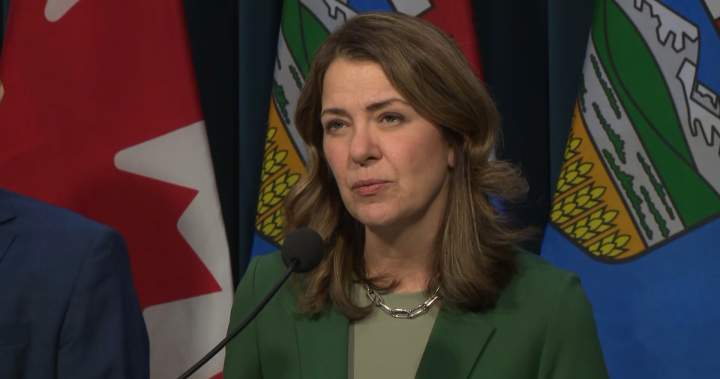
Alberta’s government is investing $143 million to create 476 new “complexity teams” in elementary schools across the province, saying increasingly complex classrooms require additional in-class support for both students and teachers.

The funding follows the collection of new data from 89,000 classrooms in 1,549 schools, highlighting the need for more support.
While the data shows that Alberta’s average class size remains within what the government describes as acceptable ranges, it also indicates that classroom composition and complexity are rising quickly.
Premier Danielle Smith said the investment is based on the recent data collection.
“We said we would use better data to make better decisions, and that is exactly what we are doing,” Smith said in a release on Thursday.
Each complexity team will include one teacher and two educational assistants.
The teams will be placed in K-6 schools and provide in-class assistance tailored to student needs, including academic, behavioural, social and emotional support.
The province says the teams will help students learn English, support those with mild or severe needs, manage disruptive behaviour and provide enrichment where required.
Schools will also be able to draw on additional specialists when necessary.

Get breaking National news
For news impacting Canada and around the world, sign up for breaking news alerts delivered directly to you when they happen.
“Every child deserves a safe, supportive classroom where they can learn, and every teacher deserves the backing they need to do their job well. We will keep taking practical, evidence-based action to make that a reality across Alberta,” Smith said.
Education and Childcare Minister Demetrios Nicolaides said the move focuses resources on early grades “before they become larger issues.”
“Establishing complexity teams will help teachers manage increasingly diverse classrooms and most importantly, make sure that more students are able to receive individual attention,” Nicolaides said.
The province says research shows early intervention during the formative kindergarten-to-Grade 6 years is more effective and less costly than trying to address behavioural or academic gaps in secondary school.
Of the total funding, $129 million will go to schools identified as highest priority based on complexity factors.
Another $14 million will be directed to schools facing unique challenges requiring different or additional strategies.
More than half of the 476 complexity teams will be allocated to metro school boards.
The Calgary School Division will receive 118 teams, while the Roman Catholic Separate School Division will receive 53.


Meanwhile, the Edmonton School Division is set to receive 101 teams, and the Edmonton Catholic Separate School Division will receive 42.
Lynnette Anderson, chief superintendent of Edmonton Catholic Schools, said the investment is a step in the right direction.
“Today’s investment of dollars to support teaching and learning is a positive step towards addressing the ongoing issue of classroom complexity,” Anderson said.
According to the data released on Open Alberta, the province’s overall average class size is 25 students.
Kindergarten to Grade 3 classrooms average 22 students, while grades 4 to 6 average 25. Classes in grades 7 to 9 and grades 10 to 12 average 26 students.
Meanwhile, rural schools report an average class size of 23 students, compared with 26 students in urban and metro schools.
The data also shows five per cent of classrooms have been identified as high priority for complexity, while 36 per cent were identified as medium priority.
The release stated that classroom complexity is measured by the number of identified student needs within a class.
Those categories include English as an additional language; mild or severe needs; individualized program plans; First Nations, Métis and Inuit students; gifted students; refugees; students on wait-lists for assessment and other factors.
A classroom is considered high complexity if it includes seven or more of those categories.
The province says the Class Size and Complexity Cabinet Committee will continue reviewing data and working with school boards to develop longer-term solutions.
© 2026 Global News, a division of Corus Entertainment Inc.
Canada,Education,alberta schools,Calgary Educationalberta schools, Calgary Education, Canada, Education#Alberta #invest #143M #classroom #support #schools1770927727