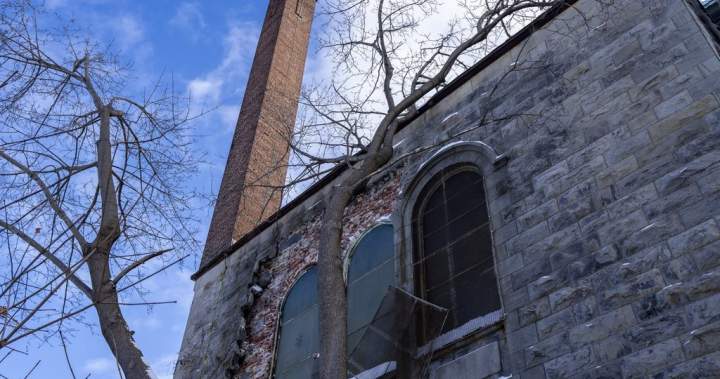
In 2023, the Ste-Marie-de-l’Isle Maligne church in Alma, Que., completed its transformation into the St-Crème — a combination hotel, ice cream shop and event space. It’s one of dozens of churches that have been restored in recent years, with some finding new vocations as climbing gyms, housing or distilleries, while others continue to offer religious services and community spaces.

However, experts say the Quebec government’s decision last year to suspend programs that provided financial aid for church renovations and transformations is putting future projects in jeopardy, just as soaring renovation costs are pushing more churches to close.
Cameron Piper, an adviser with Conseil du patrimoine religieux du Québec — the heritage group that administered the funds — says church closures have been an ongoing story ever since his group began tracking them in 2003. And he expects the trend to accelerate as attendance continues to decline and repair costs skyrocket.
“I think that our general feeling … is that we’re kind of on the edge of a precipice, where a lot of this is going to start accelerating pretty rapidly in the next few years,” Piper said. “Just because we’ve noticed that, while we do have already a lot of churches closing and a lot of churches changing vocation, what we have a lot more of are churches that are kind of just on the brink.”
The most recent count by Piper’s group found that of 2,751 places of worship — of all denominations — in the province inventoried in 2003, about 965 of them, or 35 per cent, were listed as being “in mutation,” meaning they had been closed, demolished, sold or had found new uses.
The province’s Culture Department confirmed by email that it did not renew the renovation programs, which expired in March 2025 and totalled $25 million for the most recent year. A 2025 report commissioned by the province “highlighted the fact that the status quo is not a viable option and that sustainable solutions must be identified in consultation with all stakeholders,” spokesperson Catherine Vien-Labeaume wrote.
“Therefore, the programs, in their existing forms, were not renewed in order to consider the best solutions for religious heritage, including aspects related to financing.”

Get breaking National news
For news impacting Canada and around the world, sign up for breaking news alerts delivered directly to you when they happen.
Instead, Culture Minister Mathieu Lacombe announced in July 2025 that the province would form a committee to study and “modernize” the province’s approach to heritage preservation. The committee is expected to come up with a set of recommendations by October 2026. In the meantime, Vien-Labaume said financial assistance is still available for urgent situations.
Piper said the funding that was suspended included a program that provided grants for religious groups to help develop business plans for transforming their places or worship. Another program — used by heritage churches, including Montreal’s Christ Church Cathedral — was earmarked for restoration projects, for such things as masonry, foundation and roof work.
Solange Lefebvre, who holds the chair in cultural and religious diversity at Université de Montréal, says the impact of cancelling the grants will be “catastrophic,” particularly for small towns that don’t have the funds to renovate or repurpose their buildings.
“It’s very surprising that they’re threatening to suspend these budgets, which seem extremely modest to me for the value that this heritage represents,” she said.
Lefebvre said the changes also risk Quebec’s place as a world leader in saving church buildings through repurposing. “We’re more advanced than many European countries because we’ve accepted not keeping all places of worship,” she said. “In some countries that was very sacred — they didn’t touch that. We’ve been pragmatic for a long time, aware that some places can change.”
As an example, she cites a church in St-Modeste, Que., in the Bas-St-Laurent region, that became a multi-functional space that still holds services but also hosts the town library, events and city council meetings.
Both Lefebvre and Piper believe that the provincial government’s aggressive push toward stricter secularism rules are making church conversions, such as the one in St-Modeste, more difficult.


While secularism wasn’t cited as a reason for cancelling the funding, they say the province’s tough approach has made municipalities reticent to partner with religious communities that want to retain a presence in the buildings, out of fear of running afoul of the law.
Piper says the law mandates that no religious group should have privileged access to a space versus others, “which I think as a statement no one explicitly disagrees with.” However, he said some municipal governments, in practice, have been unclear on how exactly to interpret the rules when drafting agreements or seeking funding, creating “grey areas” that are difficult to navigate.
As an example, Lefebvre cites a situation in Montreal where an elected official told her there was interest in transforming a church into a library, but the project wasn’t proceeding because the religious community wanted to continue holding services there.
“With secularism we are quite uncompromising on these issues, so there is also a lack of flexibility,” she said.
In the Culture Department’s email, Vien-Labeaume wrote that “efforts to modernize the management of religious heritage in Quebec must be carried out in accordance with the Act respecting the laicity of the State. However, there is no causal link between this act and the non-renewal of the programs of the Conseil du patrimoine religieux du Québec.”
With government funding reduced, some religious communities have been looking at other ways to fund their operations. The Montreal archdiocese last year launched its own non-profit real estate arm to manage the sale and redevelopment of church properties that are no longer needed.
Stefano Marrone, the non-profit’s CEO, says there are some half-dozen properties on his desk that need urgent attention. In one case, the parish of Saint-Eusèbe-de-Verceil is asking a judge for a permit to demolish its fire-damaged, long-closed church, in the hopes of attracting a developer to partner with them build housing on the site.
Other cases could involve sales to non-Catholic religious communities, municipalities or private interests, with conditions or no-flip clauses to ensure the buildings go to community use.
Marrone said in an interview he’s hopeful that the provincial renovation grants come back, but in the meantime, the diocese wants to develop its own sources of funding.
“If we can auto-finance what we’re doing and reinvest into our properties and not draw from the same well (as other churches), I think that’s a bonus to everybody and we would be that much better off, not just the Catholic Church, but as a society,” he said.
Politics,Quebec politics,SecularismQuebec politics, Secularism, Politics#Loss #government #funding #secularism #putting #Quebec #churches #brink1770820240