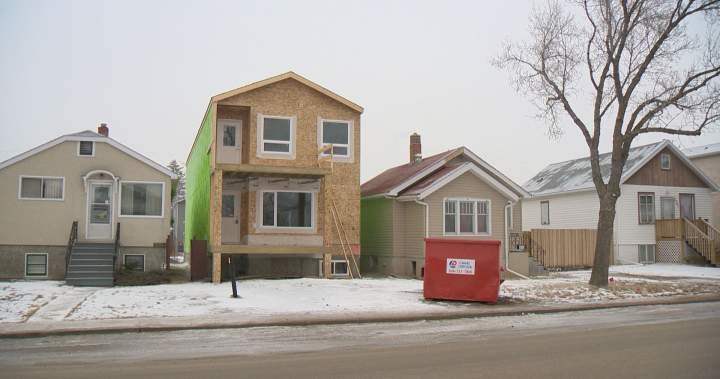
For two days, the city council urban planning committee heard from several speakers about Edmonton’s residential zoning regulations as it reviewed amendments that would see more restrictions placed on infill development.

On the table are a few changes, including dropping the maximum number of units midblock to six from the existing eight, while also increasing the minimum size of a unit.
Over the course of two days, 70 speakers took time to voice their concerns and it became clear the amendments are not popular with some people on either side of the infill debate.
Coun. Aaron Paquette said there are no wrong arguments.
“Whether you’re dealing with the facts and the figures and the needs of the city or you’re dealing with the change of a neighbourhood or the feeling of not knowing what’s going to happen, those are all valid concerns,” Paquette said.

Council has been tasked with balancing the need for more affordable housing that developers actually want to build and people are willing to buy or rent with the concerns of existing residents about property values, not enough parking, predatory developers, quality of builds and housing affordability.
Paquette noted Edmonton is dealing with a massive population catch-up from hundreds of thousands of new people moving to Alberta in recent years, while there are also federal grants for multi-unit builds that developers are being enticed to take advantage of.
“So we see this natural spike based on those artificial or unusual circumstances. When those go away — and they will, like the pressure of the population and the pressure of that grant — we get back into a normal state of development and so what happens there? And should we change policy mid-stream in an unusual time? Or do we see how it plays out over the next six months and then revisit?”
Representatives from Edmonton’s development community argue that further restrictions could impact their profitability, which would in turn drive up the cost of infill housing.

Meanwhile, owners of mature homes said six units on a single lot that previously contained a single-family home is still too many. Some argued that a unit reduction doesn’t even necessarily equate to smaller buildings.

Get breaking National news
For news impacting Canada and around the world, sign up for breaking news alerts delivered directly to you when they happen.
“It’s all about the massing,” said Kathy Hawksworth, who lives in the south Edmonton Parkallen neighbourhood and is with the Residential Infill Working Group.
“A huge building is a huge building whether it has one, two, six or eight dwellings in it.”
Hawksworth noted large infills can affect the privacy and sunlight of neighbouring yards, affecting plants and energy efficiency investments, like solar panels.
“The loss of gardens, the loss of solar: these have real impacts for residents that are quite apart from whether it’s six units or eight units, or in fact one unit or two.
“It’s all about the massing size, the sheer volume of these huge buildings.”

A handful of presenters at the urban planning committee on Monday and Tuesday were from the Residential Infill Working Group.


They said the issue is largely the size of the multi-family housing buildings popping up next to bungalows or other much smaller existing homes.
“Infill can fit in nicely, we just need to do it nicely. We just need to do it right,” said Beverly Zubot, who is with the Residential Infill Working Group. “We need some tweaks in the zoning bylaw to make that happen.
“We’re hoping we can sit down with city administration and the development industry, builders, to come up with those metrics.
“The kind of things that will work for everybody.”
They presented a number of potential solutions, including lining up front setbacks with existing homes and splitting housing among a front home and back garage suite, with yard in the middle — breaking up big walls that block sunlight.
“The best format is to have four [units] in the front and two in the rear, and I guess that’s why we’re really encouraging the six-unit cap because that creates the building pattern that now exists in our lovely mature neighbourhoods with trees, with large enough space in between the rear building and the front building for landscaping, amenity areas, gardening, et cetera,” Zubot said.
Other speakers expressed a desire to leave the existing zoning rules as they are, feeling they’ve been successful in developing more homes in mature neighbourhoods and more affordable rents.
When councillors on the urban planning committee began questioning city administration Tuesday afternoon, many of their queries surrounded how amendments would effect change that actually remedies problems Edmontonians are bringing forward.
In the end, the committee decided to send the debate to city council, where the public hearing process will start over again.

In 2023, the City of Edmonton changed zoning bylaws to allow for more multi-unit buildings up to three storeys in all neighbourhoods.
The aim was to encourage a variety of development to be built more easily in residential areas.
Since then, there’s been mixed reaction to the increase in multi-unit buildings replacing single-family homes.
Infill ended up being a contentious topic during the 2025 fall municipal election campaign after residents of established communities expressed concerns with property values, not enough parking, predatory developers, quality of builds and housing affordability.
© 2026 Global News, a division of Corus Entertainment Inc.
Canada,Consumer,City of Edmonton,Edmonton infill,InfillEdmonton infill, City of Edmonton, Infill, Canada, Consumer#days #Edmonton #infill #debate #city #committee #sends #decision #council1770816565