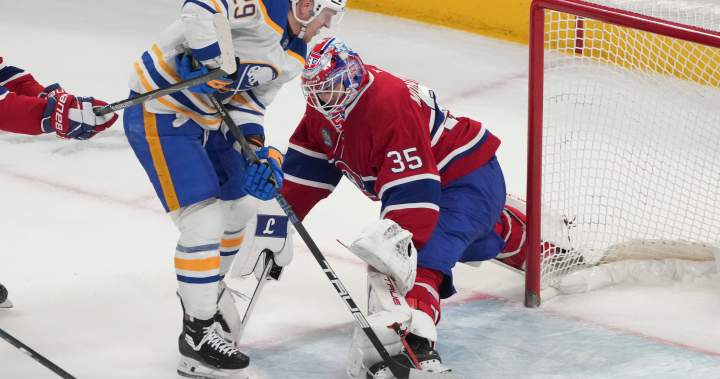
The Buffalo Sabres were a pushover 40 days ago. They were one of the worst teams in the league heading for a 15th straight season without a playoff spot.

Somehow, though, they rattled off 16 wins in their last 20 games.
They’ve become a big test for any team. The Montreal Canadiens lost to the Sabres last week, and they did again this week in another close game 4-2.
Wilde Horses
Credit to the Canadiens that they found themselves down three, but didn’t mail in the rest of the night. They were a proud group trying to get back into the game led by their captain Nick Suzuki. He was quintessential Nick, playing at a highly intelligent level.
The Canadiens dominated the second period in shots 14-3. Suzuki was the architect of the opening Montreal goal, digging out the puck with Mike Matheson and already knowing, if he won the puck, what he would do. He directly fed Cole Caufield who one-timed his 26th of the season.
Still in the second, it was Zachary Bolduc with the steal in the Buffalo zone. His first shot was stopped, but Suzuki pounced on the rebound for his 16th of the year.
The catalyst for the entire comeback was the third line of Phillip Danault, Brendan Gallagher, and Josh Anderson.
This line is starting to get some real chemistry going. They have a strong forecheck that even though they make lack finish around the net, they create the energy for their team and the exhaustion for the other team that game flows in Montreal’s direction.
Bolduc played one of his best games in a long while. He is starting to figure out his routs to take. He brought a stronger forecheck, and work ethic. Players often think they are working hard, until the find another gear higher, and then realize that they weren’t actually at the level of their teammates.
Bolduc is still very young, and improvements are still quite possible for him.
Wilde Goats
When assessing blame for a goal against, it’s popular to finger one player for the difficulty.
However, it’s rarely just one player who is responsible for a goal against. It generally takes two, if not three, of the six on the ice to lead to a goal against.
On the Sabres’ first goal, three Canadiens committed small errors that led to the key first goal of the game. Lane Hutson tried a pinch that was likely ill-advised. Another truth in hockey about a goal against is it is rarely the first player that errs far up the ice that is most at fault.
After Hutson’s poor pinch, there were still 120 feet of ice to go for the Sabres who shouldn’t have had a two-on-one. This is because in the system any pinch needs a forward to cover. That’s the hope, though it doesn’t always work out, and it is difficult to track blame.
On this goal, though, it was fairly easy to assess. Kirby Dach couldn’t create enough back pressure as he was late for the pass across the crease to stop the easy shot. That brings us to the pass, and that has its share of blame as well.

Get daily National news
Get the day’s top news, political, economic, and current affairs headlines, delivered to your inbox once a day.
On a two-on-one, the defender assesses the position of the shooter, and if the angle is bad, he lets the shooter take his chance from that angle. He creates an angle so the pass isn’t available. Jayden Struble didn’t do that.
That’s three mistakes on one goal. That’s usually how it works, though people like to point to one player most of the time.
The only one who wasn’t at fault was Samuel Montembeault, who managed to let in the first goal on the first shot yet again. However, on the second goal, after Noah Dobson was beaten to the outside, Dobson did create a nearly impossible angle for the shooter.
Beck Malenstyn had only one play on the goal. He was too tight for a shot. He was too tight for short side. He could only drag it across the net to the far side, yet Montembeault cheated to the short side and let in a low-percentage attempt.
Another goat in this one was the lineup. Struble is not a better defender than Arber Xhekaj, so any time he is chosen, the head coach is making a prediction that it’s going to be a tame game. When the prediction is wrong, the Canadiens are short-staffed in the intimidation aspect of the contest.
In the first five minutes, tempers got heated already. Jason Zucker hit Kaiden Guhle directly in the face with a hit. Guhle went down to the ice. The referee missed it, which added to the dilemma of the moment. The Canadiens all looked at the hit and no one responded.
This simply can’t be. This can’t be the message that is sent by the Canadiens players. When it’s dirty, five guys need to basically go after the aggressor. Later in the game, Zucker needed to take the best Xhekaj could throw at him. Xhekaj needs to be in the lineup.
If the sixth defender isn’t Struble, but Bobby Orr, then a coach makes a ‘talent’ decision. But when there is nothing in the talent assessment between them, Xhekaj has to be the ‘intimidator’ decision.
Two other minor notes of issues that need to be addressed. It can’t be long for Hutson and Stuble as a pairing. Firstly, Hutson is better on the left side, so playing on the right already diminishes him. Hutson also doesn’t have confidence to roam freely offensively with Struble. A much better partner for Hutson is Alexandre Carrier, who is playing his best hockey of the season.
The other note is Dach. This thought may be early, because it is only two games since he has returned from injury. In fairness, he deserves a longer look to get his wind and his timing before pulling him, but, so far, he doesn’t look a fit for the first line.
It’s interesting that the conversation about a second-line centre has been popular in Montreal for years, but after acquiring Danault, a companion for Suzuki and Caufield seems the biggest need on the roster. There’s an Alexander Zharovsky in the future, or a Michael Hage, but, for this season, it feels like the search is still on.
The correct winger on the first line would ignite the top-six in a massive way.


Wilde Cards
“Marty is the best coach that I could have hoped for in my career. He taught me the right way to play. He opened my eyes to ways of reading the game. He was incredibly patient with me, even in the toughest moments.” – Juraj Slafkovsky
Culture. Most of the time, it’s overplayed. It’s a rare occasion that it actually is special in a locker room of a professional franchise. In fact, the honest truth is it might be one of the most overplayed fallbacks there is.
For every one time that culture is actually good in a room, there’s another nine times that it is complete and total nonsense. It’s difficult for players to pull for each other. They desire the same job.
A goalie wants the other goalie to succeed knowing that means less of the net for him? A fourth liner trying to keep his career alive at $1 million wishes for his replacement to succeed, so he can make $90 thousand in the minors? The power play specialist gets replaced on the first unit hopes the new guy scores? Does any of that seem easy?
The truth is it can be a cutthroat competitive environment. There’s a small number of jobs, and a finite amount of money available in an NHL career. For some, a career is just a cup of coffee, and they don’t feel like pouring some out. Generally speaking, players worry about ice time much more than each other, because, with an injury, tomorrow is never guaranteed.
However, there’s something about the leadership of Head Coach Martin St. Louis that brings out the best in people.
Juraj Slafkovsky’s quote above isn’t about just his breakout season. It’s about how playing under a great coach can transform your attitude, so you can discover that improving as a player, in a team environment, is the true bottom line.
Something is happening in the Canadiens locker room. St. Louis said they are trusting the process so much so that they are learning it and then helping each other to advance it. That’s not cutthroat. That’s a band of brothers.
Players are also taking hometown discounts. Mike Matheson, Kaiden Guhle, Lane Hutson, Slafkovsky, and more are all taking less than a protracted negotiation could have brought. They want to be a part of this.
That starts with the head coach teaching them how to “read the game” and “play the right way” That influences their pay grade in the long run, as well. A better hockey player gets paid more.
However, a head coach can’t just be about IQ and X’s and O’s. It’s also vital that a coach is patient in the process.
Teaching is an art that is simply not appreciated enough in our world. From kindergarten to our careers, we are influenced at times in our lives by teachers in ways that last forever. Half of us will never forget our Ms. Clay in the third grade.
And teaching never stops. As amazing as the top 700 hockey players are in the entire world, they are still developing their craft. They need a leader and a wise man about their craft and about life to reach their goals.
You only fight to the end, and give every ounce you have when you believe with all your heart in your purpose.
This head coach is a true mentor giving them that purpose.
Culture: Sometimes it’s nonsense, but sometimes it’s the reason it all comes together.
Brian Wilde, a Montreal-based sports writer, brings you Call of the Wilde on globalnews.ca after each Canadiens game.

Sports,Call of the Wilde,HABS,Montreal CanadiensCall of the Wilde, HABS, Montreal Canadiens, Sports#Call #Wilde #Montreal #Canadiens #face #Buffalo #meet1769137298