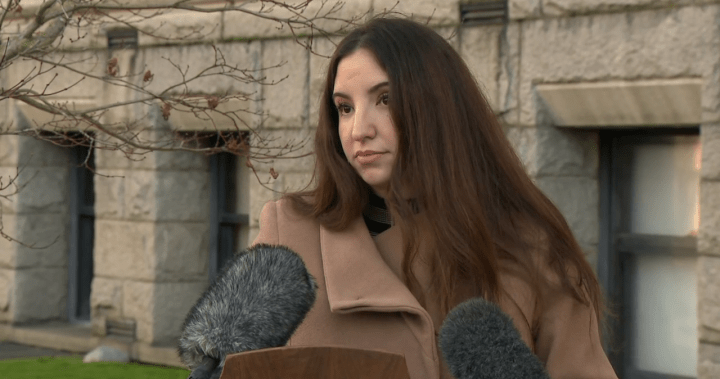
A B.C. woman who has terminal cancer spoke out on Wednesday about how she feels the province’s health-care system is overloaded and needs help.

Sara Gilooly said that while waiting for tests to be performed, her cancer spread from her breasts to her lungs and her bones.
“My cancer story began in May,” Gilooly said.
“I just had received a major surgery. And I felt a lump about a week later in my breast. And it was huge.”
After a mammogram, an ultrasound and a biopsy, it was determined that Gilooly had breast cancer.
“At that point, we pushed the panic button,” she said.
“My family called doctors, friends, families. We even reached out to a hospital in Türkiye to see what their suggestions were. Within a few days, they gave us a full list of the things that they would do and the tests that they run to check if I had metastatic cancer — how big my tumours were, what was going on, something that the Canadian system didn’t unfortunately do.”
Gilooly said she stayed at the breast cancer centre in Abbotsford, where the staff were wondering and the surgeon was great and she was told after her surgery that everything looked good. She had clear margins and no lymph node involvement.
She said the hospital in Türkiye did ask for some pathology, including a marker for the Ki-67 protein, which shows how fast cancer cells divide.
“This, I wish I would have gotten here and I wish that patients from now on can get something like this because if they saw this with my tumour grade being three and my age of 40 — I had just turned 40 — they would have known that the cancer cells are going to be aggressive,” Gilooly said.
“Women with cancer that are diagnosed in their 20s, 30s, and 40s typically have a much higher, much more aggressive type of cancer.”

Gilooly said she asked about getting a PET scan, a CT scan and an MRI, but was told she didn’t need it and they didn’t want to put more radiation in her body.
“I was conflicted,” she said.

Get weekly health news
Receive the latest medical news and health information delivered to you every Sunday.
“I understood what they meant by the radiation, but to me, I didn’t understand why we weren’t looking for more things. When I asked when I was going to meet with my oncologist, it was going be two months out.”
Gilooly said that almost everything she asked for, she received pushback from the system.
“I am all for advocating for myself, and I’m quite good at it, but it is a full-time job and it feels exhausting when you’re already emotionally drained from getting terrible news such as cancer,” she said.
Gilooly added that she received a lot of support from the Self-Management Health Coach Programme at the University of Victoria and she even reached out to the Mayo Clinic in the United States.
“I just really wanted to know what other people were doing and what other countries were doing, because I felt like our system was just letting me down a little bit,” she said.
“Even though the doctors and surgeons have been amazing, it was the wait times that really, really bugged me. And I’m a doer, I can’t just sit still. So I did the best I could. The system kept telling me I wasn’t a priority because all my margins were clean.”
When she finally did see an oncologist, Gilooly said she was disappointed to find out that one of the tests she had asked for hadn’t even been done, even though she felt it could have been requested while she waited.


When that test came back, it showed a high risk of the cancer returning.
Gilooly got a CT scan, a PET scan and an MRI and they all found something.
“In November, it came back as metastatic in the lungs,” she said.
“And I am grateful for my oncologist and that she trusted her instincts and she acted because without her saying those tests need to be done, I could have gone through the treatment and still had metastatic breast cancer.”
Gilooly said she can’t help but think that the little treatment she had from July to November could have made a difference in her outcome.
“Our system is overloaded,” she said.
“Our doctors, our patients, our nurses, our central diagnostics, they’re all overloaded and they urgently need help.
“I did everything I was told, I waited, I trusted, I tried to advocate for myself. I wonder still if I should have left, if I should have gone to Türkiye, or if I should have gotten to a different hospital. A part of me is happy that I got to spend time with my community, with my friends, and especially my family.
“But now I’m wondering, is this going to prevent me from spending more time with them? Lives depend on us helping and changing the system. And I hope that together we all can.”

Independent MLA Amelia Boultbee says Gilooly’s story is not unique.
“British Columbians lost their lives in 2025 on wait lists, and over 25,000 people in the same time period had to leave the province just to get medical care,” she said.
“So this is, unfortunately, a massive, systemic problem.”
Global News reached out to the B.C. Health Ministry and BC Cancer for comment but did not receive a response by deadline.
Health,Politics,BC health care,Health care crisisHealth care crisis, BC health care, Health, Politics#waited #trusted #B.C #woman #terminal #cancer #healthcare #system1769067456