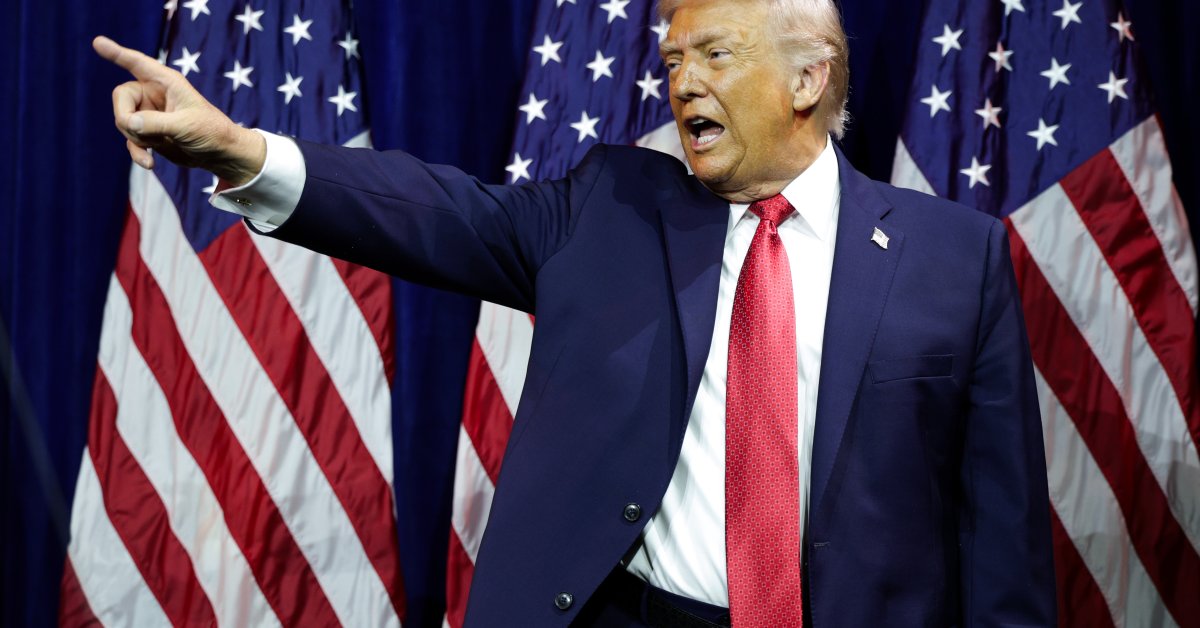
President Donald Trump is seemingly trying to redefine what counts as an American citizen. Since returning to the White House, he’s not only ramped up his immigration crackdown, but has also questioned the citizenship status of foreign-born U.S. citizens, sparking mass concerns over the potential weaponization of denaturalization.
Trump has paid particular focus to Minnesota, on account of the widespread investigations regarding fraudulent schemes targeting government-funded programs within the state. The President has used the scandal to target Minnesota’s Somali community and has accused them of “destroying” the state, on account of some people of Somali descent being found guilty of involvement with the schemes. He has seemingly taken to blaming the community as a whole rather than the individuals involved.
Referencing members of the Somali community, Trump confirmed this week that his Administration is looking into stripping some Americans of their naturalized state. “I would do it in a heartbeat if they were dishonest,” Trump told the New York Times in an interview conducted Wednesday night. “I think that many of the people that came in from Somalia, they hate our country.”
Although the Trump Administration is actively looking into the criteria for taking away citizenship, the President did not specify the exact foreign-born groups that would be targeted. Instead, he said: “If they deserve to be stripped, I would, yes.” Trump also did not specify what exactly would constitute one to “deserve” the denaturalization process and whether or not he was referring to the current legal parameters for denaturalization.
TIME has reached out to the White House for comment.
This is far from the first time Trump and members of his team have referenced denaturalization as part of ongoing efforts to crackdown on immigration. In December, during an appearance on Fox & Friends, White House press secretary Karoline Leavitt said the Administration was “looking at” revoking the citizenship of people of Somali descent if they are convicted in the fraud cases. This somewhat echoed Trump’s own words, as he previously said “send them back to where they came from,” in reference to members of the Somali community in Minnesota.
Trump has even targeted individuals with his threats.
He has expressed his desire to strip America-born adversaries of their U.S. citizenship, although it’s unclear how he would legally seek to do that. The President twice threatened to revoke the citizenship of New York-born comedian Rosie O’Donnell, one of his decades-long sparring partners. O’Donnell, who moved to Ireland following Trump’s election win in 2024, has rebuffed his commentary.
But Trump’s main focus has been on foreign-born American citizens. He previously questioned the citizenship status of New York Mayor Zohran Mamdani, who was born in Uganda and became a U.S. citizen in 2018. And in December, he lashed out at Rep. Ilhan Omar of Minnesota, who was born in Somalia and gained her U.S. citizenship aged 17 in 2000. During a speech in Pennsylvania, Trump told a rousing crowd: “We ought to get her (Omar) the hell out.” He then listened as the crowd chanted “send her back.”
Should Trump, who campaigned on a platform of mass deportation, follow through on his threats against foreign-born Americans, it would mark a significant escalation of his immigration crackdown. In November, the President said he was terminating the Temporary Protected Status (TPS Program) for Somalis in Minnesota. After a shooting in Washington, D.C. killed National Guard member Sarah Beckstrom—a crime for which an Afghan national emerged as the sole suspect—Trump ordered a reexamination of green card entries into the U.S. for people from 19 countries, including Somalia. That list of countries with full or partial travel restrictions was later expanded to 39.
Following that, in December, internal documents from the Trump Administration to U.S. Citizenship and Immigration Services (USCIS) field offices reportedly pushed a monthly quota for denaturalization figures going into 2026. The USCIS offices were requested to “supply Office of Immigration Litigation with 100-200 denaturalization cases per month,” in guidance obtained by the New York Times. The quota would be a sharp increase in the number of cases for denaturalizing U.S. citizens, with 305 cases filed between 1990 and 2017, an average of 11 annually, prior to Trump taking office, according to the National Immigration Forum.
Trump’s first term saw a higher case number than the average, with 42 filed annually under his Administration.
What is the legal basis for stripping an American of their citizenship?
Per U.S. federal law, a naturalized American can only have their citizenship removed “if there is deliberate deceit on the part of the person in misrepresenting or failing to disclose a material fact or facts on his or her naturalization application and subsequent examination,” according to USCIS.
Cases of successful denaturalization mostly come down to if the misrepresentation was wilful, and such misrepresentation led to the person in question gaining their citizenship, or if the citizenship was procured illegally.
A naturalized citizen can also be revoked of their status “if the person becomes a member of, or affiliated with, the Communist party, other totalitarian party, or terrorist organization within five years of his or her naturalization.”
The USCIS will refer such cases for revocation should there be “sufficient evidence to establish that the person is subject to one of the grounds of revocation.” These cases have no statute of limitations, according to the Justice Department, which in 2020 created a dedicated department for denaturization during the first Trump Administration.
Uncategorized,Donald Trump,News DeskDonald Trump,News Desk#Trump #Threatens #Denaturalize #U.S #Citizens #Deserve1767968864