On Jan. 20, one of the coldest days of the year in Minneapolis, Ali Daniels received a text message warning that ICE agents were targeting school bus stops in Columbia Heights. Daniels, an office administrator working in the metro area, had recently completed legal observer training and was participating in rapid response work for the second time.
Grabbing a friend as her passenger seat sidekick, the two patrolled the neighborhood for signs of ICE activity. After about 10 minutes of turning down residential streets, they spotted a large SUV stopped in the middle of the road. She recalls seeing ICE agents in masks and tactical vests standing outside the vehicle.
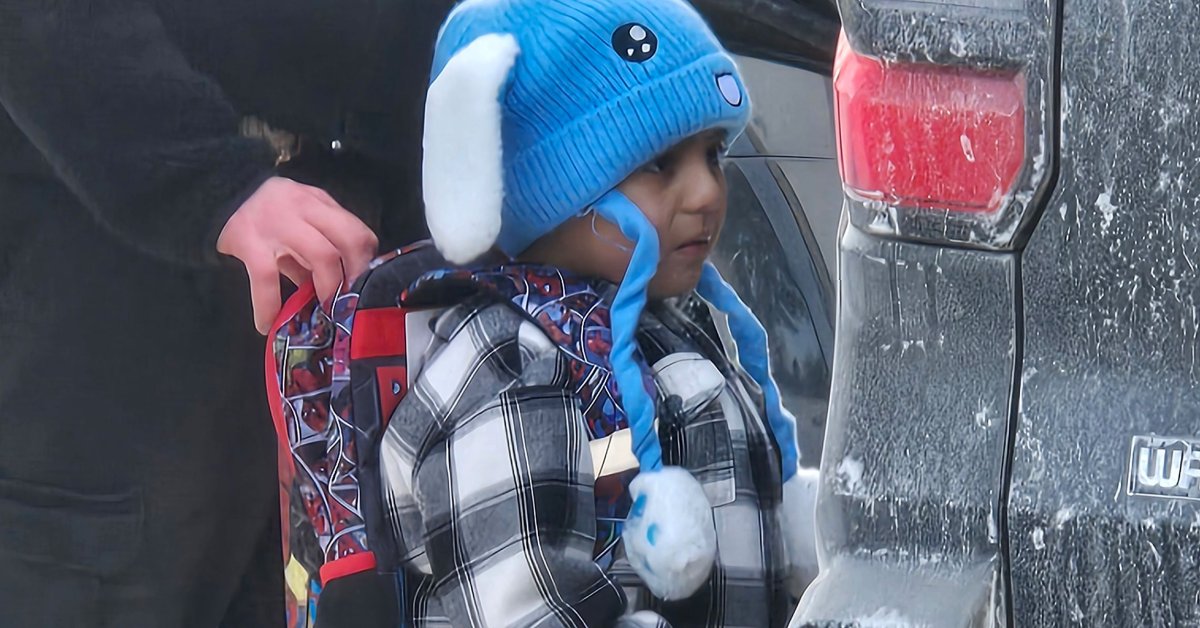
That’s when Daniels saw Liam Conejo Ramos—a small, wide-eyed child in a Spider Man backpack and blue bunny hat—being escorted to a slush-streaked car. Daniels recalls agents shouting “get it in the car,” referring to Liam.
People at the scene pleaded with the agents to allow the five-year-old to go with authorized staff from Columbia Heights schools, where Liam attended pre-kindergarten classes. Daniels says the agents refused.
“I decided to start taking pictures,” she said. “This wasn’t part of the training; it was something I did out of impulse.”
Daniels took out her Samsung to snap photos of the agents, the vehicle, and then bent down to Liam’s eye-level. “He was silent, staring ahead, undoubtedly scared and in shock,” she said. “That’s when I got the photo of him.”
Daniels posted the image to her private Facebook page, unaware of the journey this one photograph would take.
We all know this photo and the surrounding details intimately now. Liam was returning from school with his father when immigration agents pulled them from their car near their home, according to the school district. The boy’s father, Adrián Alexander Conejo Arias, was also detained, and the pair were transferred to an immigration detention center outside San Antonio.
A lawyer for the family said that Mr. Conejo Arias, who is from Ecuador, had entered the United States under existing asylum guidelines. The Department of Homeland Security, however, charged that he entered the country unlawfully in Dec. 2024. DHS spokesperson Tricia McLaughlin said in a statement that “ICE did NOT target a child,” and that the operation was instead to arrest the child’s father.
Against this backdrop, Daniels’ image of Liam’s seizure went mega-viral at a moment when public anger over immigration enforcement was already acute in Minnesota and elsewhere across the country—the incalculable, inescapable kind of viral in which images move faster than explanation.
X, Instagram, TikTok, Facebook, and BlueSky were flooded with versions of the photo: cropped, captioned, subtitled, paired with legal explainers, donation links, and calls to action demanding Liam’s release. The power of these posts came from their terrifying precision: that this child could be anyone’s, that Minneapolis could be home.
By Jan. 31, Judge Fred Biery, a U.S. District Judge for the Western District of Texas, ordered the release of both Liam and his father from immigration custody, condemning their removal from their suburban Minneapolis neighborhood as unconstitutional. At the bottom of his three-page ruling, Judge Biery included the viral photograph of Liam with the caption: “Matthew 19:14” and “John 11:35.”
Those New Testament verses quote Jesus saying “Let the little children come to me” and “Jesus wept.” The image that had proliferated on social media was now part of the legal record.
After more than a week in detention, Liam and his father were released from the Texas immigration facility and returned to Minneapolis, according to U.S. Representative Joaquin Castro. Castro documented the trip on social media, where he shared a photo of a handwritten note he gave Liam, in which he wrote that the boy had “moved the world.”
“Liam is now home. With his hat and his backpack. Thank you to everyone who demanded freedom for Liam,” Castro, a San Antonio Democrat, wrote on X.
To be sure, this is not the first social movement in which social media has played a central role in global political resistance. During the Arab Spring, platforms like Facebook and Twitter functioned as organizing tools and distribution channels for footage that state-controlled media suppressed—most notably in Egypt in 2011, when live updates and images from Tahrir Square transformed local protests into an international crisis within days.
A decade later, mass mobilization around Black Lives Matter was catalyzed by cellphone video made by then 17-year-old Darnella Frazier documenting the murder of George Floyd, turning a single Minneapolis street into the epicenter of a worldwide uprising.
Since the racial justice protests of 2020, however, political posting has existed under sustained suspicion as performative. During the summer of 2020, critics of all ideologies mocked symbolic gestures untethered from action: black squares on Instagram, TikTok videos of white influencers (hair done, makeup snatched) raising fists to trending audio, memes lampooning allyship that required no material risk.
That skepticism has lingered over the past several years, particularly when crises feel distant or abstract, where posting about Sudan or Gaza, for example, can resemble a stand-in for action. “Spreading awareness” remains notoriously difficult to measure.
What makes this moment distinct is that the debate no longer feels theoretical. As recently as last week, reposting Liam’s photo was criticized as performative on platforms such as TikTok. But the outcome complicates that charge. The circulation, and the demands it elicited, forced visibility, legal scrutiny, and response.
The spread of Daniels’ photo of Liam shows how public pressure on social media can still bend the machinery of the state.
This is not to say that posting is enough. It is easy to criticize a celebrity wearing a political pin on the red carpet (or a Facebook infographic, or a hashtag in an Instagram bio) as virtue signaling. Talk can only take you so far.
Social media can also flatten nuance. As the photo was reshared and reposted on Facebook, Daniels began seeing comments questioning its authenticity, suggesting it was fake or AI-generated. She decided to identify herself as the photographer to establish the image’s provenance.
“It’s hard to be told you’re changing hearts and minds with one photo, yet knowing that no amount of saying ‘I saw this firsthand’ will make people see how cruel and unjust the whole institution is,” Daniels told me. “Nothing is that easy.”
Liam is far from the only child impacted by the Trump administration’s policies. According to a Guardian analysis of records obtained by the Deportation Data Project, ICE booked about 3,800 minors into immigrant family detention from Jan. to Oct. 2025. The number of children currently in migrant detention centers remains unclear. Posting on social media will not free the thousands of children currently detained.
Minnesotans like Daniels with a cell phone camera are demonstrating in real time how social media can push beyond symbolism into tangible change. The photograph of Liam, videos of the killings of Renee Good and Alex Pretti, and other images have contributed to stepping up the pressure on the federal government, ultimately forcing a reversal of its tactics in Minnesota.
And social media is proving to be an indispensable tool for coordination. Instagram, X, Facebook, Threads, WhatsApp, and Signal are being used to track ICE activity, mobilize protests, circulate witness requests, and distribute precise call and email templates for elected officials. On streets across the country, Americans are putting their own bodies on the line to impede the operations of a federal police force in their city.
“Like so many people in the Twin Cities, I got trained [as a legal observer and rapid responder] because I felt like I had to,” Daniels said. “I couldn’t just do nothing while our neighbors are being snatched up from their homes.”
Instead, she turned to her phone’s camera. Her image not only helped change the life of one child, it helped change policy.
Uncategorized,politicspolitics#Story #Viral #Photograph #5YearOld #Liam #Conejo #Ramos1771071189