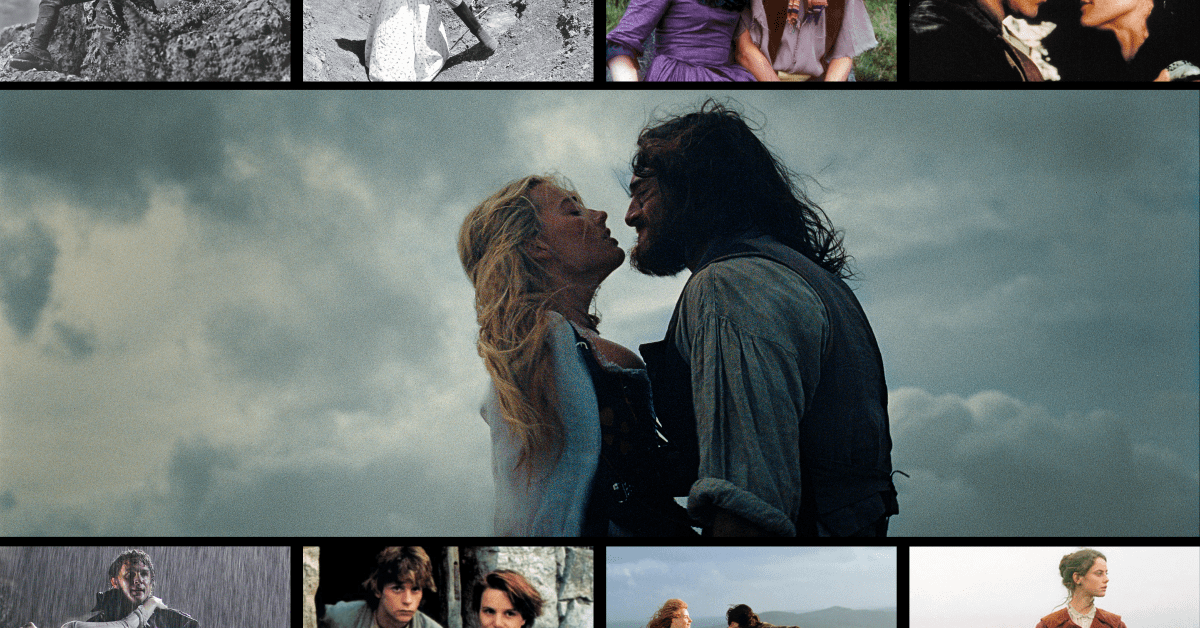
The mark of a great, tough book may not be how many literature classes it’s taught in but how many film or TV adaptations you can drape on its branches without breaking them. Dramatizations are tricky business: No film-viewing experience can match the way an individual imagination—yours or mine—brings a writer’s words to life. Yet dogged faithfulness isn’t the goal, either. A film can be spiritually faithful to a book even when it jettisons whole shards of plot. A good adaptation is a lover, not a fighter; it entwines itself with a work, rather than clawing away at it.
Emily Brontë’s 1847 wind-thrashed sycamore of a novel, Wuthering Heights, holds power even over those who haven’t read it. No wonder filmmakers have been drawn to it almost since the advent of movies, beginning with the first known version—a 1920 British silent, now lost—and ending, for now, with Emerald Fennell’s candy-colored bodice ripper starring Margot Robbie and Jacob Elordi, which barely holds a dripping, gothic candle to any of the others (but more on that later). That means, whether you’ve read the middle Brontë sister’s novel or not, there’s a Wuthering Heights film or TV dramatization for you.
In fact, there are dozens, including a 1988 Japanese incarnation, a 2015 retelling set in a California high school, and several versions from India, a Bollywood musical among them. That said, not everyone loves Brontë’s book: For every reader who adores its intricate plot and discomfiting view of humanity, there’s at least one more who trudged through it in high school or college, never to return. Yet its polarizing effect may be the key to its magnetism; even those who dislike it have certainly absorbed some of its fragrant dolorousness into their bones. And although scholars are still debating whether Brontë set out to write a romance—she may have been more fixated on dissecting Victorian societal strictures—nearly everyone connects with the romantic, if dangerous, allure of the lovers at the heart of this story.
There’s Cathy, the spirited Yorkshire lass who’s fully in tune with the brutal, beautiful landscape in which she was born, though she also yearns for genteel comforts; and Heathcliff, the outsider of low birth who grows into a vengeful young man and, let’s just admit it, a smoldering symbol of unattainability and hotness. Did I mention that their imperishable bond involves necrophilia and an angry ghost? Though Brontë couldn’t have imagined the idea of movies in her lifetime, she created two characters—living, breathing phantoms of our own faults and desires—who were made for this particular interplay of shadow and light.
Let’s start with a Wuthering Heights that’s not for neophytes: Peter Kosminsky’s 1992 film features two dazzling stars—Juliette Binoche and Ralph Fiennes—but it’s curiously inert on the screen. It also highlights some of the problems of adapting this elaborately plotted work, a highwire act on Brontë’s part that involves a multigenerational revenge scheme enmeshing Cathy’s daughter and Heathcliff’s son, individuals born of the two lovers’ mixing with outsiders. Unless you’re mounting a 10-episode miniseries, some plot points will have to go, but Kosminsky’s reading is just too truncated. And though Robert Fuest’s 1970 version, starring future James Bond Timothy Dalton, has the nastiest psychosexual undertones of the 10 adaptations addressed here, it’s still a dud: Dalton’s wily Heathcliff, though handsome, is not particularly alluring. For a compact yet full-bodied blast of the Wuthering Heights experience, try the relatively faithful 2009 BBC adaptation starring Tom Hardy and Charlotte Riley, who met on set and became a couple in real life. Their scenes together have an erotic earthiness unmatched by almost any other onscreen Heathcliff-Cathy combo.
Which Wuthering Heights best matches the story’s jagged, haunting landscape to the fighting spirit of its central lovers? That would be Andrea Arnold’s 2011 version, starring James Howson and Kaya Scodelario. Though Brontë described Heathcliff as being “dark,” and it’s generally assumed that he’s meant to be Romani—or perhaps Irish—Arnold entertains another possibility: in this chilly, bracing reading, Heathcliff is a Black man, a choice that reinforces his outsider status. And for sheer spookiness, Peter Sasdy’s 1967 made-for-BBC-TV Wuthering Heights—starring Angela Scoular and Deadwood’s Ian McShane—is calling across the moor. This four-part series—whose director would go on to make several Hammer horror films—demands patience; it’s one of the few adaptations that attempts loyalty to Brontë’s plot, and it sometimes feels stiff and stagy. But the fact that it exists only in a spectral black-and-white version (the original color version no longer exists) makes it weirdly haunting. And its sound design is killer: The howling winds of the countryside figure in nearly every scene, indoors and out. This is also the version that inspired Kate Bush to write “Wuthering Heights,” a song that captures, like the flame inside a well-cut jewel, the story’s romantic obsessiveness.

Brontë’s novel has so much atmospheric power that it can survive translation to settings beyond hardscrabble Yorkshire. New wave master Jacques Rivette’s languorously alluring 1985 version sets the story in the sun-dappled Cevennes region of France. And Luis Buñuel’s deliciously named 1954 adaptation, Abismos de pasión, generates even more heat: Irasema Dilián and Jorge Mistral bring shimmering midcentury glamour to a story set in a hot, shrubby yet frequently rainswept desert.
Yet of all the Wuthering Heights adaptations, two stand tall—if, befitting the story, they’re still admirably twisted. David Skynner’s 1998 version, made for British TV and starring Robert Cavanah and Orla Brady (as well as a young, pre–Pride and Prejudice Matthew Macfadyen), leans into Heathcliff’s cruelty by including crucial details—the way, for instance, he confesses to having killed a nestful of baby lapwings by placing a net over their nest, preventing their parents from reaching them. This Wuthering Heights is visually gratifying (you’ve never seen more fabulous moonlit curls than on Cathy’s ghost) while also being a little florid and suitably sick.
But the finest Wuthering Heights is also perhaps the most famous—and, in terms of plot, possibly the least complete. In his 1939 version, William Wyler shaves away huge chunks of the story. But his lead characters breathe on the screen as they do in no other adaptation: Merle Oberon captures both Cathy’s capacity for earthbound delight and her desire for earthly finery; you might disapprove of her, but you can’t hate her. And Laurence Olivier may be the most sympathetic of all onscreen Heathcliffs. With his stern brow and unyielding gaze, you know he’s bad news, but his vulnerability is implied. Olivier’s Heathcliff is the ultimate “I can fix him!” boyfriend—not a good model for reality, but deeply alluring in fiction.
Which brings us to Emerald Fennell’s fan-fiction Wuthering Heights. Fennell has said that her version is intended not as a faithful re-creation but a reimagining, a good starting point for any adaptation. (As the critic Robin Wood once put it, “To reduce a great novel to its plot is merely to reveal a total incapacity for reading it.”) But that doesn’t mean you have to love Fennell’s creation. Her Cathy and Heathcliff, played by the admittedly gorgeous Robbie and Elordi, play slapstick jokes on one another, including a bit involving raw eggs: this, and some running to and fro through the craggy countryside, is supposed to indicate their connection to nature’s raw power. There’s lots of clandestine sex—after being separated and reunited, this Heathcliff and Cathy go at it like cartoony rabbits—but no carnality. Their assignations bump along methodically, PowerPoint-style. Even Cathy’s wardrobe disappoints: after she leaves the gloomy homestead where she and Heathcliff were raised and moves into her rich husband’s house, she’s decked out in a series of stiff, shiny dresses that look to have emerged from the $1.99-per-yard fabric bin, beloved by broke community-theater costumers everywhere.

Fennell also doesn’t bother dramatizing the way Heathcliff digs up, and embraces, Cathy’s corpse, a missed cinematic opportunity if ever there were one. And there are no ghosts here, though you will see a random hanged corpse with an erection. Brontë’s Wuthering Heights is a bleak book, but it’s not an ugly one: beneath its cloud cover of misanthropy, there’s feral, wildflower grace. Fennell has tossed all of that out, substituting her own unimaginative vision, plus a bunch of crappy dresses. A pretty dismal Valentine to a book a filmmaker ostensibly loves, this Wuthering Heights is hate-reading in movie form.
Uncategorized,culturepod,Magazinemovies,culturepod,Magazine#Watched #ltigtWuthering #Heights #Adaptationsltigt #Heres #Whats #Worth #Time1771005159