When a storyteller has made their magnum opus—a work that brilliantly synthesizes their experience and voice and most profound insights, a tale only they could tell—what are they supposed to do next? Many of the past decade’s smartest TV creators have, in response to this impossible problem, turned to a life of crime. Donald Glover followed up the category-exploding Atlanta with serial-killer standom satire Swarm and a tragicomic take on Mr. & Mrs. Smith, about married assassins. After rendering a contemporary Native American community in specific, surreal, often hilarious detail in Reservation Dogs, Sterlin Harjo turned to noir with The Lowdown. Phoebe Waller-Bridge plumbed the darkly comic depths of sex-positive feminism in the first season of Fleabag, only returning to the project after creating the deliriously fun cat-and-mouse spy thriller Killing Eve.
Like those auteurs, Lisa McGee broke through with a sui generis comedy that mined aspects of her own experience to find authentic humor in a harrowing situation. Derry Girls, which followed teens in McGee’s native Derry in the years preceding 1998’s Good Friday Agreement, was a raucous, joke-dense show that juxtaposed mundane adolescent rites of passage with the daily horrors of life in Northern Ireland during the Troubles. Now McGee, too, is back with a crime drama—one bound to earn comparisons to Sharon Horgan’s post-Catastrophe murder romp, Bad Sisters. Combining the latter show’s core of complicated relationships between women (and its fondness for outfitting those women in enviable knitwear) with the sidesplittingly verbose, extremely Irish sensibility of Derry Girls, her new Netflix series How to Get to Heaven From Belfast lands as both an example of the pivot to crime drama and a commentary on it. The plot gets a bit woolly towards the end, the mix of tones doesn’t always work, and I sometimes wished I could watch its central girlfriends do anything besides play amateur detective. Still, even if you’re over whodunits, McGee’s cleverly meta spin on an overdone genre and her genius for comedy, dialogue, and character development make for an altogether good craic.
The premise is enough of a murder-show Mad Lib to suggest, correctly, that a creator of this caliber won’t be taking it at face value. Three childhood friends are summoned to the wake of the estranged fourth member of their high school clique, with whom they shared an awful secret. In a series of flashbacks, we’re gradually given context for the haunting image of four girls watching fire consume a cabin. Now pushing 40 and navigating various midlife crises, the women are ensnared in a tangle of new and old mysteries. Relevant clichés include: You can’t go home again. Hurt people hurt people. The past is never dead. It’s not even past.

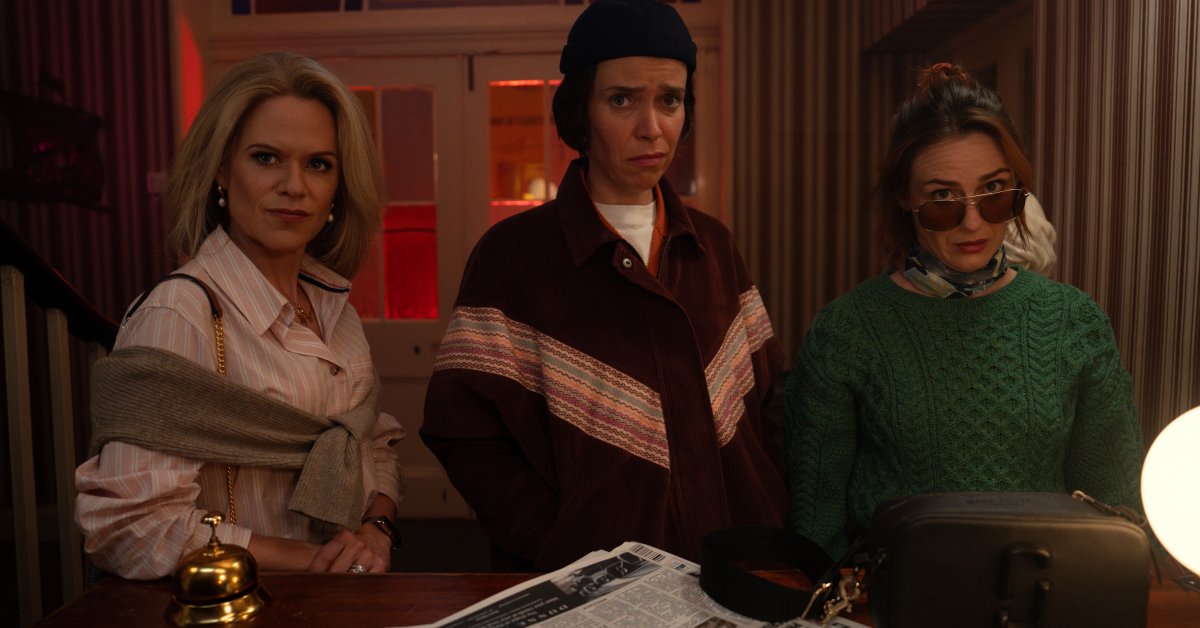
This otherwise unpromising setup is made not just bearable, but a genuine pleasure by the central trio. Self-dramatizing Robyn (Sinéad Keenan from Being Human) has grown up to be a harried mum of three rambunctious boys, wasting her spark in a meh marriage. Dara (Industry and A Thousand Blows standout Caoilfhionn Dunne) is a semi-closeted lesbian whose life has been circumscribed by her Catholic faith and familial caretaking duties; she’s a bit awkward, and you get the sense that loneliness has made her this way. To the extent that Belfast has a single protagonist, it’s Saoirse (Roisin Gallagher, recently seen in Lazarus and The Dry), the writer of—meta conceit incoming—a TV crime drama called Murder Code. Feuding with its star and squabbling through an engagement to a coworker, she’s having doubts about the path she’s chosen. “What even is it?” she demands, referring it Murder Code. “It’s just, ‘Look, someone’s got themselves murdered again.’ Is that what I do?” “You entertain a lot of people,” her flack protests. Saoirse: “So do f-ckin’ clowns.”
If you hadn’t already suspected that McGee had more in mind than someone’s got themselves murdered again, here’s your giant, flashing neon sign. Whether or not her profession makes Saoirse the creator’s surrogate, she’s certainly the character whose perspective gives the show its thematic framing. Funny, foulmouthed, Irish-slang-laden banter is McGee’s signature; who else would make space in a tense scene for someone to opine that Belle from Disney’s Beauty and the Beast “is a dick. The way she slags off her town like she’s the only person who’s ever read a book”? When they’re being serious, though, Robyn, Dara, and even Saoirse tend to have critical things to say about the habit writers like Saoirse have of manipulating not just the worlds they dream up, but also real people they treat as posable characters. Belfast is especially alert to how far from reality the supposedly true stories we tell ourselves and each other can be.

Accordingly, a series of mostly unpredictable twists reveals, bit by bit, that everything these women think they know about that fiery night 20 years ago—that is, everything they think they know about the ordeal that still defines each one in her own mind—is wrong. In that sense, every choice they’ve made as adults has been premised on a lie. It’s a fascinating head trip to send the characters on, at the same time as they’re motoring around the emerald countryside and beyond, scrambling to figure out what actually happened to their friend and, of course, stop their potentially ruinous secret from getting out.
I would’ve been content to watch this quieter inquiry into what it means to base your identity on bad information develop amid the investigation and the unparalleled repartee (“DNA doesn’t wash off. It’s like Catholicism”). But as the season goes on, and especially in its second half, the mystery gets too big. The cast of characters expands in directions that verge on fantasy—which does, at least, enable a virtuosically unhinged performance from Derry Girls star Saoirse-Monica Jackson, albeit in a role that could have been guest-written by Emerald Fennell. And the monolithic theme that is trauma threatens to overshadow McGee’s unique and specific exploration of how we cobble ourselves together out of simplistic, often spurious, narratives.
Belfast is doing too many things, metamorphosing too many times, to succeed at everything it tries. But it works more often than it doesn’t, because it’s constructed around the same two pillars that made Derry Girls so solid: lovable, complicated characters and gallows humor that is both skillfully written and flawlessly delivered by an ideal cast. That doesn’t necessarily mean I’m convinced that McGee is just as well suited to crime drama (or meta crime drama) as she was to comedy. It would be a shame if, as popular as it is, crime became the only genre in this austere, murder-mad era of streaming that could support original stories from accomplished creators. Belfast is an enjoyable enough place to visit, but Derry still feels like home.
Uncategorized,culturepod,reviewTelevision,culturepod,review#ltigtDerry #Girlsltigt #Creator #Turns #Crime #Netflixs #Intriguing #ltigtHow #Heaven #Belfastltigt1770945996