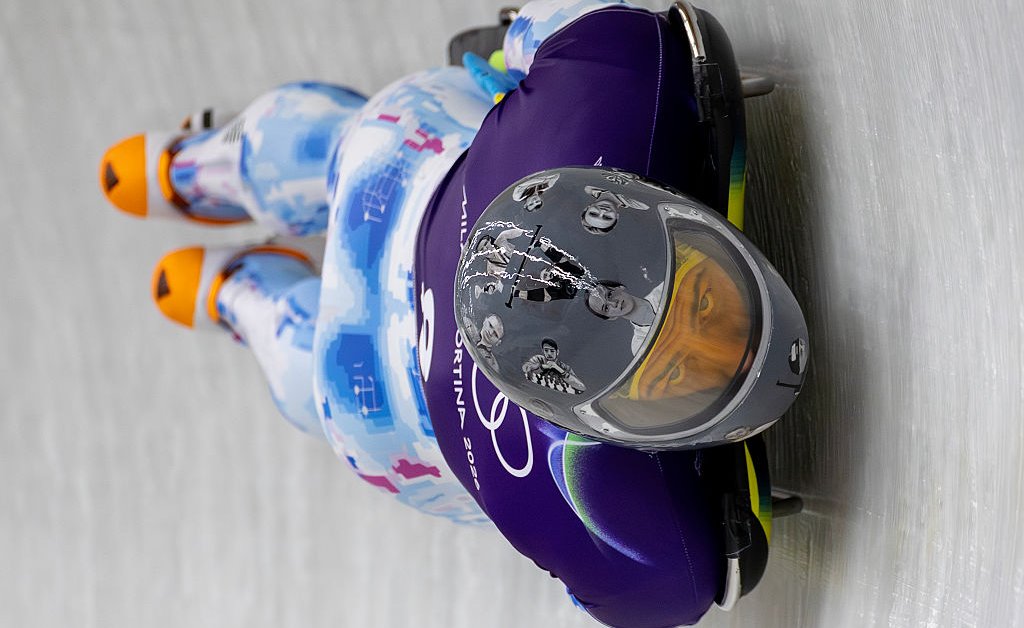
A Ukrainian athlete is facing potential disciplinary action over his determination to wear a helmet commemorating athletes killed in the war with Russia when he competes in the Olympics—despite the International Olympic Committee (IOC) barring him from doing so.
Skeleton racer Vladyslav Heraskevych, who served as Ukraine’s flag-bearer during the opening ceremony of the Winter Games, has continued to wear what he calls his “remembrance helmet” in training after the IOC ruled it a violation of the Olympic Charter’s ban on political speech. At a Wednesday press conference, the IOC warned that there could be consequences if Heraskevych keeps wearing it.
“He can, and we would encourage him, to express his grief, but in the end let me be clear. It’s not the message, it’s the place that counts. There are 130 conflicts going on in the world. We cannot have 130 different conflicts featured, however terrible they are, during the field of play, during the actual competition,” said IOC spokesperson Mark Adams. When asked what would happen if Heraskevych wore the helmet in competition, Adams responded: “I don’t think it is helpful to speculate. But obviously there are rules and regulations that the athletes themselves want us to enforce, and they will ultimately be enforced.”
The Ukrainian racer would be permitted to wear a black armband instead of the helmet, the committee suggested a day earlier, as a compromise.
But Heraskevych has decried the IOC’s ruling against the helmet, which features the images of a number of Ukrainian athletes who have died in the war, and vowed that he will wear it while racing in spite of the possible threat of disqualification.
“Earlier we asked, and now we demand the lifting of the ban on using the ‘Memory Helmet’ during competitions at the Olympic Games,” he wrote in a post on X on Wednesday. “It is obvious that it does not violate any IOC rules.” Acknowledging support he has received for his helmet, Heraskevych said in a post later in the day that “the sacrifice of the people depicted on the helmet means more than any medal ever could – because they gave the most precious thing they had. And simple respect toward them is exactly what I want to give.”
The first heat for the men’s skeleton competition is set for 9:30 a.m. local time on Thursday.
Read more: Despite Protest Rules, the Olympics Have Never Been Neutral
Heraskevych is so far the only athlete at the 2026 Milano Cortina Winter Olympics who has run afoul of the IOC over the Olympic Charter’s Rule 50, which states that “no kind of demonstration or political, religious or racial propaganda is permitted in any Olympic sites, venues or other areas.” But the Olympics have regularly been the site of protests and political messages, despite the committee’s efforts to impose restrictions, and a number of other athletes have used the international stage presented by this year’s Winter Games to make statements about political events or conflicts impacting their home countries.
Here’s what to know about Rule 50—and the history of athletes speaking out at the Olympics.
What is the Olympic Charter’s Rule 50?
Olympic officials have long sought to limit political demonstrations and displays at the Games. IOC restrictions on such protests date back more than seven decades, to the 1955 Olympic Charter, though their parameters—and athletes’ response to them—have changed with the intervening years.
The basic framework of what is now known as Rule 50 was introduced in the 1975 charter, which stated that “every kind of demonstration or propaganda, whether political, religious or racial, in the Olympic areas is forbidden.” The language expanded the parameters of restricted demonstrations to include racial as well as political acts of protest in what was interpreted to be a response to Black athletes who used the 1968 and 1972 Games to promote messages of racial justice.
The current Rule 50 guidelines, developed by the IOC Athletes’ Commission, give a “non-exhaustive list” of actions that could constitute prohibited protests, such as displaying political messaging, including signs or armbands; “gestures of a political nature, like a hand gesture or kneeling”; and “refusal to follow the Ceremonies protocol.”
The guidelines also specify venues at which protests and demonstrations are not permitted under Rule 50: on fields of play, in the Olympic village, and during medal ceremonies and the opening and closing ceremonies.
They also stress, however, that “it should be noted that expressing views is different from protests and demonstrations,” and list some settings where athletes do “have the opportunity to express their opinions” during the Games.
These notably include press conferences and interviews, in which many American athletes have spoken about the political situation in the U.S. during this year’s Winter Games. Athletes are also permitted to express their views on media platforms and at team meetings.
The guidelines state that the rule applies to “everybody, not just the athletes,” including the head of state of the host country, who must abide by a specific script at the opening of the Games. Government officials are also barred from appearing at medal ceremonies.
“It is a fundamental principle that sport is neutral and must be separate from political, religious or any other type of interference,” the guidelines read. “Specifically, the focus for the field of play and related ceremonies must be on celebrating athletes’ performance, and showcasing sport and its values.”
Disciplinary action is taken on a “case-by-case” basis in instances in which athletes are found to violate Rule 50, per the guidelines.
Ukraine battles the IOC’s helmet ban
Ukraine is pushing back against the IOC’s decision to bar Heraskevych from wearing his remembrance helmet at this year’s Games. Ukrainian President Volodymyr Zelensky offered support for the skeleton racer in a post on X, thanking him “for reminding the world of the price of our struggle” and saying that “this truth cannot be inconvenient, inappropriate, or called a ‘political demonstration at a sporting event.’” The Ukrainian team appealed the ban.
And Heraskevych’s fellow Ukrainian athletes at the Games have also publicly demonstrated their support. Luger Olena Smaha held up her glove to display the words “Remembrance is not a violation” written across the palm on Tuesday, while the skier Dmytro Shepiuk displayed a small piece of paper bearing the words “UKR heroes with us” on the palm of own glove on Wednesday.
Heraskevych himself has repeatedly spoken about the helmet and denounced the IOC’s decision to prohibit it in interviews and social media posts.
“The world must know the price of freedom,” he said in a video on social media Monday night, in which he showed the helmet and the images of the athletes displayed on it.
He has cited several symbolic displays and acts of commemoration by other athletes at the Winter Games that have not met with sanctions. He noted, for instance, that an Italian snowboarder wore a helmet bearing the Russian flag, among other countries’, without facing reprimand from the IOC, despite Russian athletes having been barred from wearing the flag at the Olympics since the invasion of Ukraine in 2022.
In posts on his X account, Heraskevych also pointed to the Israeli skeleton racer Jared Firestone, who posted a video saying he would wear a kippah with the names of the Olympians who were taken hostage and killed during the 1972 Olympic Games in West Germany; U.S. skater Maxim Naumov, who lost his parents in a plane crash in Washington, D.C., last year and honored them by displaying a photograph after he competed on Tuesday; and Great Britain skier Gus Kenworthy, who posted a photo on Instagram with the words “f-ck ice” apparently urinated in the snow ahead of the Winter Games in reference to U.S. Immigration and Customs Enforcement (ICE).
“If this isn’t discrimination, then what should I call it?” said Heraskevych of the ban on his helmet, accusing the IOC of imposing “double standards.”
When asked for comment, the IOC referred TIME to Adams’ Wednesday press conference.
U.S. athletes speak out
Press conferences are among the venues where Olympic athletes are permitted to express their political views under Rule 50. And with the Milano Cortina Games occurring as President Donald Trump faces widespread outcry over his Administration’s aggressive immigration crackdown and foreign policy moves, several U.S. athletes have voiced concern about events unfolding back home during them.
“The Olympics represent peace, so let’s not only bring world peace but domestic peace within our country,” halfpipe skier Alex Ferreira, who has taken home medals at past Winter Games, said at a press conference on Friday. Freestyle skier Svear Irving noted that “it’s definitely a tough time in our country right now,” saying that she continues to represent her values of “compassion and love and respect for others.”
But it was remarks made by another freestyle skier, Hunter Hess, that drew the ire of Trump and his allies.
“I think it brings up mixed emotions to represent the U.S. right now,” Hess said. “There’s obviously a lot going on that I’m not the biggest fan of and I think a lot of people aren’t. Just because I’m wearing the flag doesn’t mean I represent everything that’s going on in the U.S.”
The President responded to Hess’ comments in a Truth Social post, calling him a “real Loser.” Republican Rep. Byron Donalds of Florida told Hess to “GO HOME” in an earlier post on X, saying that “some things are bigger than politics. You just don’t get it.”
U.S. snowboarder Chloe Kim, whose parents emigrated from South Korea, showed support for Hess when asked about Trump’s targeted remarks on Monday.
“Obviously my parents being immigrants, this one definitely hits pretty close to home,” said Kim, who won back-to-back gold medals in the snowboarding halfpipe at the 2018 and 2022 Winter Games. “I think in moments like these it is important for us to unite and stand up for one another. We need to lead with love and compassion, and I would love to see some more of that.”
Another snowboarder, Maddie Mastro, expressed similar sentiments at the same press conference, saying: “I’m also saddened about what’s happening at home. It’s really tough and I feel like we can’t turn a blind eye to that. At the same time I represent a country that has the same values as mine, kindness and compassion, and we come together in times of injustice.”
Trump is not in attendance at the Winter Games, but Vice President JD Vance was present at the opening ceremony, where he was greeted with a chorus of boos.
ICE has also been the subject of criticism and protests surrounding the Games: Several current and former Italian leaders expressed outrage over the news that ICE agents would aid Olympic security operations, and thousands of demonstrators gathered in Milan on Saturday, the day after the opening ceremony, to protest the agency’s presence.
The U.S. figure skater Amber Glenn, who is an outspoken advocate for LGBTQ+ rights, faced backlash after she said her community was facing “hard times” in the current political climate at a pre-Olympics press conference on Feb. 4.
“It isn’t the first time we’ve had to come together as a community to try to fight for our human rights. I hope that I can use my platform and my voice throughout these Games to try to encourage people to stay strong,” Glenn said. She stated that she received “a scary amount” of hate on social media after her comments, including threats.
The history of political protest—and official reprimands—at the Games
Heraskevych is not the first athlete whose actions at the Olympics have been judged to violate Rule 50.
In 2024, for instance, Manizha Talash, who was competing for the Refugee Olympic Team, was disqualified for wearing a cape with the words “free Afghan women” during a pre-qualifying breakdance competition.
“I wanted to show people what is possible,” Talash, originally from Kabul, told reporters.
Other recent acts of protest at the Games have apparently not been met with official disciplinary action from Olympic officials, however. U.S. hammer thrower Gwen Berry raised her fist before the women’s final at the Tokyo 2020 Summer Games, later telling reporters she was protesting racial injustice. Raven Saunders, a U.S. shot-putter who won silver in Tokyo, raised her arms and crossed them to form an X while standing on the medal podium, saying that the X was meant to represent “the intersection of where all people who are oppressed meet.”
“Protest on a podium … it is a human right,” Berry said in a TIME100 Talks interview. “It is not for the IOC to decide.”
Read more: A History of Political Protest at the Olympics
Acts of political protest at the Summer and Winter Games have a long history—as do official reprimands to those displays.
One of the most famous examples of a political statement made at the Olympics came during the 1968 Mexico City Games, when U.S. track and field athletes John Carlos and Tommie Smith raised their gloved hands in the Black power salute after the 200-meter race. They were suspended from the Games and banned from the Olympic village. Four years later, U.S. runners Vincent Matthews and Wayne Collett refused to attend the medal ceremony for their wins in the 400-meter race at the 1972 Games, and were banned from further competition.
Earlier still, before language restricting political speech was included in the Olympic Charter, there were overt efforts by countries to use the international platform as a means to political ends. During the 1936 Games in Berlin, the Nazis use the Olympics to promote racial superiority and the Hitler regime’s world power. Athletes and Jewish and African American organizations pushed for a boycott of the event, but the efforts were ultimately unsuccessful.
Uncategorized,2026 Milan and Cortina d’Ampezzo Olympics,News Desk2026 Milan and Cortina d’Ampezzo Olympics,News Desk#Olympics #Political #Speech #Restrictions1770857078