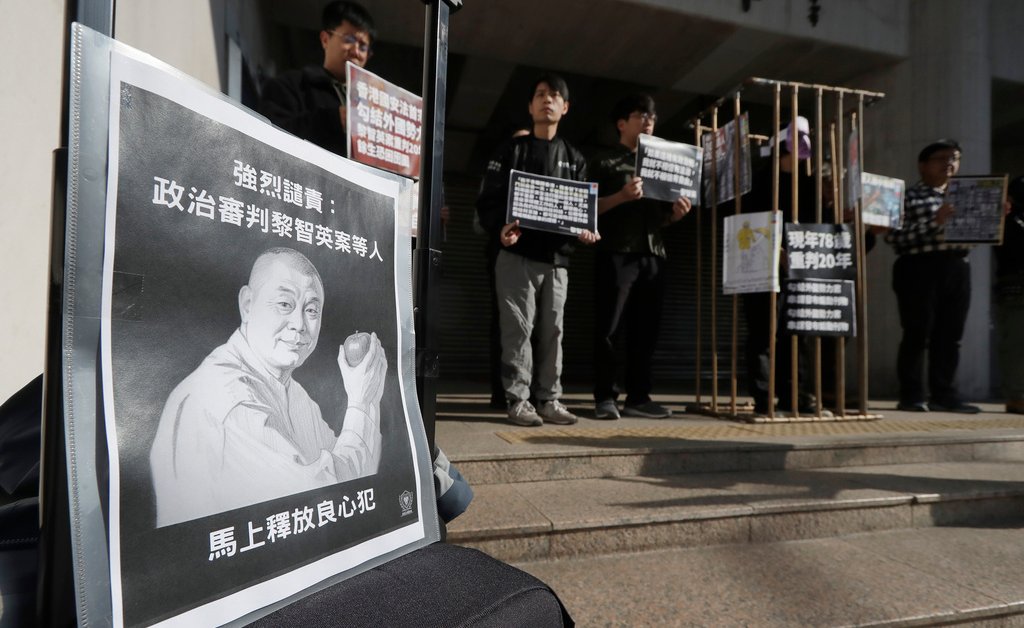
When a Hong Kong court handed media tycoon and pro-democracy leader Jimmy Lai a two-decade jail term on national security grounds on Monday, his son called it a “death sentence” given Lai’s age, 78, and deteriorating health. Critics across the globe, meanwhile, have described the sentence as a death knell for a once more free Hong Kong—as well as a signal of what could be in store for other places China has its eye on, namely Taiwan.
“I believe that the way that China is treating Hong Kong is the way that it wants to treat Taiwan next, and beyond that, other countries,” Mark Clifford, president of the Committee for Freedom in Hong Kong Foundation in the U.S., told TIME before the sentence was handed down.
A Human Rights Watch spokesperson summed up the sentiment to TIME on Monday: “Today is Hong Kong, tomorrow, Taiwan.”
Lai, a vocal critic of China’s increasing influence over Hong Kong—a special administrative region of China since the U.K. handed it over in 1997—and repression of pro-democratic voices, particularly after the passage of a sweeping national security law in 2020, was convicted in December of two counts of “conspiring to collude with foreign forces,” as well as of conspiring to publish seditious materials, as the founder of the pro-democracy newspaper Apple Daily.
But while Hong Kong and Beijing authorities and media have backed Lai’s sentence, Taiwan—the self-governed island which China claims sovereignty over—has condemned it. Taiwan’s Mainland Affairs Council said in a statement that Lai’s harsh sentence “not only deprives him of his personal liberty and tramples on freedom of speech and press freedom, but also denies the people’s basic right to hold those in power accountable.”
Taiwan President William Lai Ching-te posted on X on Tuesday that Lai’s sentencing “exposes the Hong Kong national security law for what it is—a tool of political persecution under China’s ‘one country, two systems’ that tramples human rights & freedom of press,” and he called for the media mogul’s release.
Steve Tsang, director of the SOAS China Institute in London, tells TIME that Lai’s sentence would affirm to the Taiwanese government and its people that the “one country, two systems” principle currently governing Hong Kong “is a future they cannot accept.”
That system was actually designed with Taiwan in mind. Former Chinese leader Deng Xiaoping advanced the “one country, two systems” framework as a way for Taiwan to peacefully reunite with the mainland, while “respect[ing] the realities and the existing system there.” In a bid to make the principle more palatable to the Taiwanese government, China applied it to Hong Kong and Macau after the British and the Portuguese territories were ceded back to China in the late 1990s, allowing the so-called special administrative regions to operate with their own economic system and governments.
But pro-democracy figures have argued that local governance has grown increasingly aligned with the mainland as political dissidents have either been jailed or exiled, organizations have disbanded, and a free press dismantled.
“You take a model that’s intended for Taiwan, you try it out in Hong Kong, and we’ve seen how it works out,” Clifford told TIME on Monday, adding that the freedoms and autonomy China promised to Hong Kong and the international community under the “one country, two systems” framework have all but disappeared. “Of course, Taiwan feels like it’s next.”
Uncategorized,News Desk,overnightTaiwan,News Desk,overnight#Jimmy #Lais #Sentencing #Hong #Kong #Strikes #Fear #Taiwan1770721189