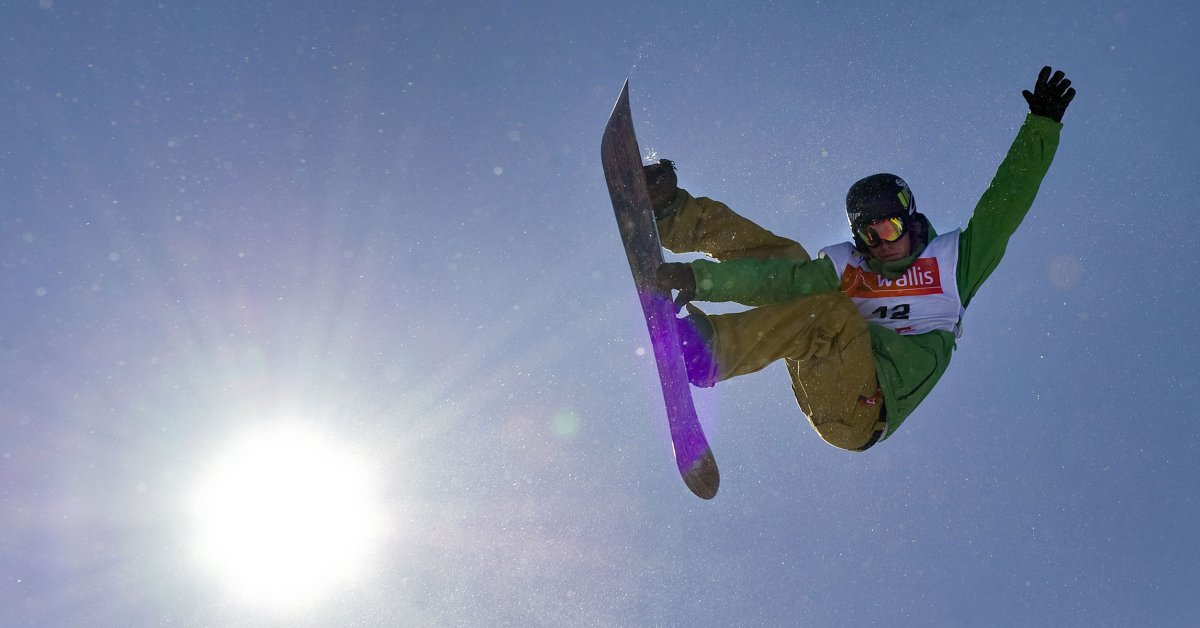
Going into the 2010 Vancouver Olympics, American snowboarder Kevin Pearce was emerging as a true threat to the supremacy of Shaun White, the superstar dubbed “The Flying Tomato” for his flowing red locks, who won gold four years earlier at the Torino Olympics. Pearce, who grew up in Vermont, had beaten White at several global events. He’s been referred to as White’s “only real rival.” They were locked in an aerial arms race, trying to one-up each other with more difficult tricks.
Then at a halfpipe event in Copper Mountain, Colo., in December 2009, Pearce fell during a preliminary run. “I was super f–cking out of it,” Pearce says. “I was feeling super dizzy and loopy.” A coach could tell something was off and instructed him to skip the next run. Pearce wouldn’t listen. “Nobody could tell me what to do,” says Pearce. He didn’t crash again, but finished 18th.
Less than two weeks later, on New Year’s Eve 2009, Pearce was practicing a double cork—two flips with multiple spins—on a pipe in Park City, Utah. It was a move he’d need in his Olympic arsenal. He landed, however, on his face, suffering a traumatic brain injury (TBI) that left him unconscious and in critical condition, required fluid to be drained from his brain, and still affects his neurological functioning to this day. He was lucky to be alive. The injury essentially ended his elite competitive snowboarding career. Pearce would never reach the Olympics.
Read More: Jordan Stolz Could Be the Michael Phelps of Speedskating
More than 15 years later, Pearce—speaking from his home in New Smyrna Beach, Fla., where he lives with wife and three children, who are all 5 or under—can’t recall what happened that day. Pearce has no memory of the accident, nor of the harrowing month that followed. In early February 2010, as the Vancouver Games were about to begin, Pearce was transferred from a hospital in Utah to a facility in Denver specializing in TBI rehab. A few months later, he returned home to Vermont to recover.
Pearce believes he pushed himself too hard. Coming back so soon from his fall in Colorado increased the severity of his Park City injury. Second impact syndrome, he insists, is all too real. “Far and away, the most important thing that anyone can learn from my accident is that if you hit your head, you’ve got to rest,” says Pearce.
The crash yielded one of the great what-ifs in American Olympic history. As great as White was—he won the halfpipe gold in Vancouver and a third Olympic title in PyeongChang in 2018—Pearce, just 22 at the time of his injury, was pushing him. It’s not beyond the realm of possibility that Pearce would have broken out as one of America’s Winter Olympic stalwarts of the 21st century, alongside the likes of Lindsey Vonn, Chloe Kim, and Apolo Ohno.
But Pearce’s ordeal—which was chronicled in the 2013 documentary The Crash Reel—has continued to produce great things. Alongside his brother, Adam, Pearce started the Love Your Brain Foundation, a nonprofit that, according to its most recent annual report, has directly served more than 57,000 people in 30 countries through programs such as retreats for brain-injury victims and caregivers, partnerships with hospitals to deliver evidence-based programming for people with brain injuries, and meditation resources for TBI patients. Pearce has also spent time on the speaking circuit; he met his wife, Kaitlyn Pearce, in 2018, after she had invited him to talk to employees at her former company, Twitter. Pearce is trying to get a scripted movie made about his life. When he’s not tending to his young family in the Florida sun, you can often find him surfing in the Atlantic.
Read More: Ilia Malinin Wasn’t Planning to Be a Figure Skater. Now He’s Favored to Win Olympic Gold
His tale is far from tragic. “I really feel like I’ve been able to help a lot of people who have dealt with a brain injury,” says Pearce. “I wasn’t helping anybody when I was snowboarding. I was helping myself.”
But daily challenges do persist. Pearce will sometimes forget grocery lists and basic instructions, and he attributes a lack of filter to his accident. One time Pearce was out to dinner with a friend and his wife, and when the check came, he accused the woman of mooching off his friend. “That ended a friendship,” says Kaitlyn. In another instance, Kaitlyn snuck in an extra half-hour of sleep in the morning, after being up all night with her baby. Pearce accused her of laziness.
“Oh, she snapped,” says Pearce.
“A lot of that is hard for me to look past,” says Kaitlyn. “It just makes a hard day harder.”
They’re powering through. Pearce will be watching the Milano Cortina Olympics: despite never getting his shot on the biggest stage, he says it doesn’t pain him to tune in. “It’s fun for me to watch those guys, because I know how it feels to win,” says Pearce. “Obviously not at the Olympics, but some of the biggest events in snowboarding. The feeling that it gives you is the best feeling in the world.”
Still, he can’t help wishing he’d had his own Olympic moment. “My God, that’s the hardest thing ever,” says Pearce. “I know it would have been next level. A lot of guys snowboarding tried to be cool. They were like, ‘I don’t like the Olympics. I don’t want to do that.’ I was like, ‘No, I’m going to go, I’m going to win.’ That’s all I wanted.”
Uncategorized,2026 Milan and Cortina d’Ampezzo Olympics2026 Milan and Cortina d’Ampezzo Olympics#Biggest #WhatIfs #American #Olympic #History1770122179