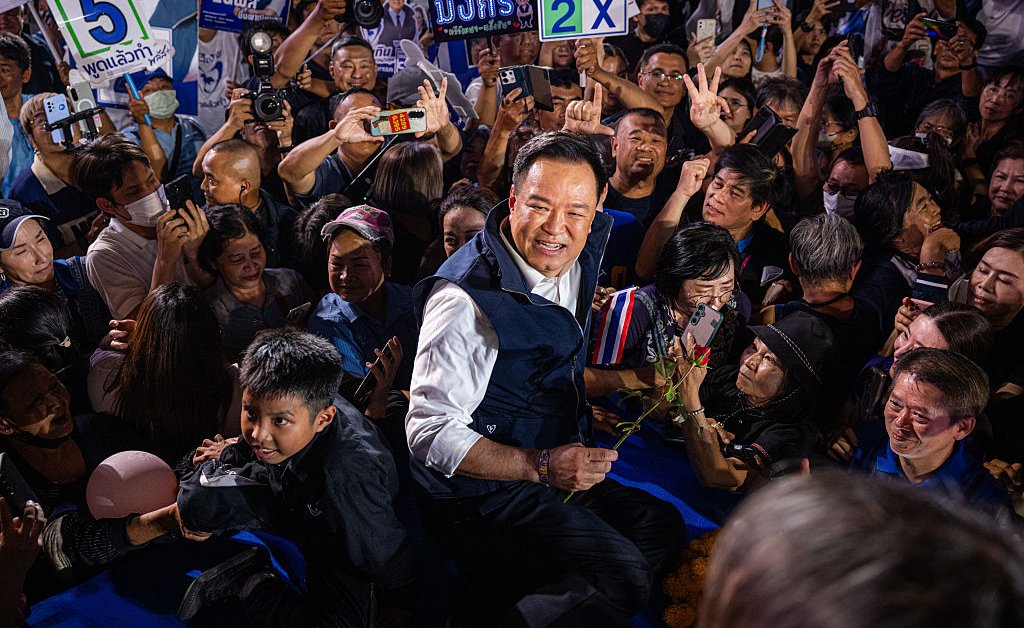
As nicknames go, Noo—or “mouse” in Thai—has proven particularly apt for Anutin Charnvirakul, whose 2016 biography, “Where There Is a Hole, There Is Mouse,” pays tribute to his canny knack for wriggling out of tight spots and into opportunities. The latest burrow that Anutin has ensconced himself in is no less than Thailand’s 1920s neo-Gothic Government House, replete with teardrop chandeliers and classical nudes, and where the burly 59-year-old today serves as the nation’s third Prime Minister in two years. Not that he appears overawed by his new digs.
“I love working regardless of my position,” Anutin tells TIME with a shrug. “As long as I can deliver my assignment and people’s expectations.”
Whether Anutin stays in his current exalted position will be decided by those people in a general election on Sunday, though judging by the cunning manner of his ascent, you wouldn’t bet against him. On Aug. 29, Thailand’s Constitutional Court removed Prime Minister Paetongtarn Shinawatra for ethical misconduct. The ruling stemmed from a leaked phone call with Cambodia’s former leader, Hun Sen, about a deadly border dispute, during which she called him “uncle” and disparaged a senior Thai Army commander as her “opponent.”
With Thailand thrust into political paralysis, Anutin—then interior minister—became Prime Minister thanks to the backing of the progressive People’s Party. The party controversially supported his candidacy in return for a promise of elections within four months, as well as a referendum on a new constitution that sought to clip the wings of Thailand’s military-royal power nexus—which, not uncoincidentally, happen to be Anutin’s chief backers.
Indeed, Anutin had other ideas. In parliament, his conservative Bhumjaithai party voted against the subsequent constitutional amendment, blowing up his Faustian pact with the People’s Party, which proposed a no-confidence vote that he was sure to lose. Instead, Anutin suddenly dissolved parliament on Dec. 12, sending Thailand back to the ballot box while retaining for himself the momentum of incumbency. In addition, dissolving parliament killed that constitutional amendment bill stone dead. Progressive lawmakers wryly noted that Noo also means “rat.”
Anutin denies accusations of “betrayal” from the People’s Party. “Bhumjaithai only promised to start the process to initiate the amendment of the constitution,” he grins. “The deal did not include that Bhumjaithai had to agree to the new constitution.”
It was a maneuvering classic of Anutin, who’s proven a political chameleon willing to blow with the prevailing winds. But whether Anutin can parlay that gamesmanship to retain Thailand’s top job is the big question. Polling puts his Bhumjaithai party in second or third place, but Anutin has several cards up his sleeve, not least backing from Thailand’s powerful brass hats and royal palace.
While Thailand’s progressive Move Forward Party won 38% of the popular vote and a plurality of 151 legislative seats in the 2023 election, it was blocked from forming a government by the senate and then dissolved by the Constitutional Court, just as its progenitor Future Forward Party had been three years earlier. In addition, 10 of Move Forward’s leaders were hit with political bans with another 44 cases pending, including 25 current lawmakers for the heir People’s Party.
It means that while the progressive movement may again win the popular vote, its reformist agenda remains anathema to Thailand’s elites and its chances of taking power are slim. “The establishment will not tolerate a People’s Party government,” says Thitinan Pongsudhirak, professor of political science at Chulalongkorn University in Bangkok.
This leaves the door ajar for Anutin to once again head a coalition government. While that would hardly be a triumph for democracy, apologists argue it may be the least-worst outcome, given nobody gains from more political upheaval, bloodshed on the streets, and the very real possibility of military intervention. (Since the end of absolute monarchy in 1932, Thailand has weathered 12 successful and nine failed coups, more than any other nation.)
Anutin’s detractors accuse him of being an anachronistic throwback to old-style venal money politics that won’t arrest Thailand’s economic tailspin. (The economy grew by just 1.5% last year.) His backers, meanwhile, say he’s a canny operator who is uniquely placed to balance Thailand’s conservative political traditions with the aspirations of regular voters.
Anutin says his goal is simple: “to win the election in order to continue the work that I wanted to do, but haven’t had enough time.”
Elections are fraught affairs in Thailand. The self-styled Land of Smiles projects a hospitable, harmonious façade in glossy tourist brochures, though control of political levers is fiercely contested. Only twice over the last quarter-century has an elected government completed a full term, with the rest all ousted by military and judicial interventions—tumult interspersed with often deadly street protests.
The old battle lines were drawn between the Bangkok-based elite and predominantly rural followers of Thaksin Shinawatra. A policeman turned media mogul, Thaksin mobilized Thailand’s populous northeast as the key to power, prompting the establishment to accuse him of vote-buying and deploy every form of skullduggery to sideline him. (Anutin was once a deputy health and interior minister under Thaksin and was banned from politics for five years when his Thai Rak Thai Party was dissolved in 2007.)
Today, Thaksin sits in jail for corruption and abuse of power, and this is the first election in recent memory that isn’t a de facto referendum on his influence. This is both due to generation shifts and the woeful performance of the last government led by his Pheu Thai party. (The recently ousted Paetongtarn is Thaksin’s youngest daughter.)

Instability in Thailand is of particular concern for the U.S., given the Kingdom is America’s oldest ally in Asia and previously served as a democratic beacon and bulwark against the communist fervor engulfing its neighbors. Yet the nation’s establishment has also been drifting closer to China. “The People’s Party’s reform agenda would be less accommodating to China,” says Thitinan.
Indeed, in November King Maha Vajiralongkorn made the first-ever visit by a reigning Thai Monarch to the People’s Republic to mark half-a-century of diplomatic ties. Anutin was also on the China trip and says he was struck by strongman Xi Jinping, leader of the Chinese Communist Party, addressing King Vajiralongkorn with fawning honorifics reserved only for the apogee of Thai royalty. “I really appreciated the way the President of China addressed my King,” says Anutin. “I felt deeply touched by the way they conducted bilateral relations.”
Still, Anutin, whose ancestors all hail from China, denies that Thailand is drifting into Beijing’s orbit and away from the U.S. “Thailand does not see the world in binary terms,” he says. “We cooperate with all partners based on mutual benefit, international norms, and regional stability.”
Anutin does, however, hope that Chinese investment can help boost a sluggish economy. Thailand suffers from weak productivity gains, a shrinking labor force, high labor informality, and crippling household debt. Vietnam, which posted 8% growth last year, is poised to overtake Thailand as Southeast Asia’s second biggest economy this quarter and is also eating its lunch when it comes to tourist arrivals, STEM graduates, and FDI.

Bhumjaithai is campaigning on subsidies, low-interest loans, and cash handouts to boost consumption, but critics say the approach merely papers over the cracks. However, Anutin’s bringing back technocrats into government—his Finance Minister is a career banker who most recently served as director-general of the Treasury—has proven popular. “People are receptive to the idea of having Thai politics more driven by professionals rather than traditional politicians,” says Napon Jatusripitak, coordinator for the Thailand Studies Program at the ISEAS-Yusof Ishak Institute in Singapore.
Indeed, Anutin insists he’s all in favor of painful structural reform and would happily break up the monopolies that stymie competition and growth—despite such reforms ostensibly being contrary to establishment interests. He says he wants to unleash a “regulatory guillotine” to slash red tape and foster a vibrant business environment. “Monopolies only benefit individuals, but deregulation benefits the whole country,” he says.
Although Anutin projects a carefully curated everyman persona, he is very much of elite stock—a scion of Sino-Thai Engineering and Construction, one of Thailand’s largest construction firms responsible for several government mega-projects, including Bangkok’s Suvarnabhumi Airport. Anutin’s father is Chavarat Charnvirakul, a former interior minister for the establishment-aligned Democrat Party. He spent eight years studying and working in New York—first reading engineering at Hofstra University followed by a stint at Mitsubishi Corporation—before returning home to take up an executive role in the family business.
Since entering public life in 1996, he has proved himself the consummate retail politician. As health minister, he greeted post-pandemic foreign arrivals with flower garlands and handed out 1 million free cannabis plants to farmers. His social media accounts are filled with singing karaoke, cooking Thai staples in a smoldering wok, or playing his saxophone. Twice divorced, he once quipped that he was “president of the hen-pecked husbands association.” He collects Buddhist amulets and is a keen aviator, flying his blue-and-white turboprop aircraft, which he has regularly used to fetch hearts, lungs, kidneys, and eyeballs back from far-flung provinces for transplant under the Hearts With Wings program.
Anutin grew to prominence by championing Thailand’s 2022 cannabis decriminalization, even wearing a marijuana leaf pattern shirt while voting in the following year’s election. But it’s a policy that chafes with Anutin’s current guise as a bastion of the establishment, highlighting his flair for political opportunism. In truth, decriminalizing cannabis was simply the most popular of several policy gimmicks his upstart party flirted with before Thailand’s 2019 election. (Others included remedying the gray legal status of ride-hailing service Grab—Southeast Asia’s equivalent of Uber—and introducing a four-day workweek.)

But as a result, tourists strolling the Thai capital have their pick of hundreds of shops emblazoned with neon marijuana leaves selling glistening buds of White Widow, Hindu Kush, and Lemon Skunk. Still, conservatives baulk at the chaotic implementation of decriminalization and farmers complain that cannabis deregulation hasn’t seeded the profitable industry promised. “I would say the rollout has been largely successful,” says Anutin, “but there is room to further tighten certain regulations after the election.”
It’s not Anutin’s only controversial policy. As health minister, he was criticized for the slow procurement of COVID vaccines as well as racist rants at Western tourists who refused to don face masks. Since becoming Prime Minister, he has been forced to apologize for botched flood relief efforts in Thailand’s deep south and a series of fatal infrastructure and transport accidents. Those failures—including two separate crane collapses within 48 hours that claimed dozens of lives— sparked intense public outrage amid accusations of a “doom loop” of graft and cost-cutting.
“We need to start by changing mindsets—at the state level, private sector and within families—so that safety becomes a new social norm, not an optional concern,” he says.
In addition, Anutin has faced censure for a lackluster response to the proliferation of online scam syndicates hugging Thailand’s frontiers with Laos, Myanmar, and Cambodia, which prompted People’s Party leader Natthaphong Ruengpanyawut to accuse Anutin of a “failure of national leadership.” But Anutin has politically benefited from Thai-Cambodia border clashes, which have hidden longstanding public concerns about undue military influence behind a veil of patriotism.
Skirmishes first broke out last May over the disputed jungle frontier with both sides deploying troops, artillery, and even airstrikes. So far, dozens have been killed, hundreds injured, and up to half a million displaced by the fighting. In late July, U.S. President Donald Trump intervened to broker a ceasefire, threatening to hike tariffs on both sides if they didn’t comply. “It’s always nice to see people who are wanting peace,” says Anutin of Trump’s intervention. Still, clashes erupted most recently in early December, just days before Anutin dissolved parliament.
“A lasting solution requires the two countries to jointly establish a mutually accepted and permanent map,” says Anutin. ‘While firmly protecting Thailand’s sovereignty, our goal is a peaceful, secure, and economically productive border.”
While sparking a serious humanitarian crisis for both nations, the fighting is politically problematic for the People’s Party. The 2023 election was framed as a vote on the military’s involvement in politics, but today the generals are ostensibly out of government—depriving the progressives of a useful foil. Meanwhile, the border crisis is stoking jingoistic pride, meaning resurgent popular support for the armed forces and Anutin as their hawkish champion. “I work with the military as colleagues, I never placed myself as their superior,” he says.
Back in 2023, the Move Forward Party floated the rhetorical question “What are soldiers for?” as part of its campaign to highlight the military’s dubious role in politics and business, including golf courses, horse-racing tracks, Muay Thai stadiums, hotel chains, conference centers, free trade zones, and even TV and radio stations. However, this question has now been resurrected and amplified by conservatives as evidence of a perfidious lack of patriotism. “The People’s Party is being attacked by all sides,” says Thitinan.
The progressives face other headwinds that make repeating their stunning victory from three years back even more challenging. In 2020, unprecedented public protests erupted across Thailand that shattered taboos by openly calling for royal reform and especially of Thailand’s draconian royal defamation law, known as lèse-majesté or Article 112, which is accused by critics of stifling all dissent. However, the Move Forward Party was dissolved on the flimsy pretense that campaigning on reforming Article 112 was unconstitutional, meaning the People’s Party has been forced to shy away from this cornerstone issue, effectively neutralizing a key liberal rallying point.

Asked whether he would consider reforming Article 112, Anutin replies without a hint of irony that “demand to amend this law has significantly subsided,” noting that “even political parties that previously sought to advance this issue have publicly stated that it is no longer part of their policy agenda.”
There’s also dissatisfaction with how People’s Party lawmakers—nearly all political neophytes—have performed on a constituency basis. Historically, Thai politics, especially in rural areas, has been dominated by influential local families, known as baan yai, who distribute cash handouts and other inducements to maintain support. The People’s Party pledged to do away with antiquated patronage politics—though now many voters are feeling the pinch. “Some have buyer’s remorse,” says Napon.
By contrast, other than technocrats Anutin’s Bhumjaithai has aggressively courted baan yai from across the political spectrum, deftly encouraging rival clans not to split the vote by competing against each other, but instead stand in separate constituencies under the Bhumjaithai banner.
Compounding matters, the People’s Party’s unholy alliance with Bhumjaithai in exchange for elections has further muddied the water for progressives. Since all parties have refused to be drawn on potential post-election tie-ups, even protest voters are at a loss where to cast their ballot lest they end up inadvertently supporting the object of their rebuke. At the same time as casting constituency and party ballots in the general election, Thais are also voting in a referendum on whether to rewrite the constitution—without any specifics of what the alternative might look like.
It has left an extremely confused, conflicted electorate. The fault lines of the last election were clear: Whether to allow the generals to continue in politics. But this time around is fuzzier, with governing style, personalities, and constituency concerns more prevalent. Certainly, polling suggests that a coalition of sorts is likely. Asked who he’d be prepared to do a deal with, Anutin issues the shrug of a seasoned opportunist. “You’ve got to see the result before making any decision,” he says. “Because you need to listen to the people. And I never fail the people.”
Uncategorized,ThailandThailand#Fail #People #Thai #Prime #Minister #Anutin #Charnvirakul #Doesnt #Plan1770026141