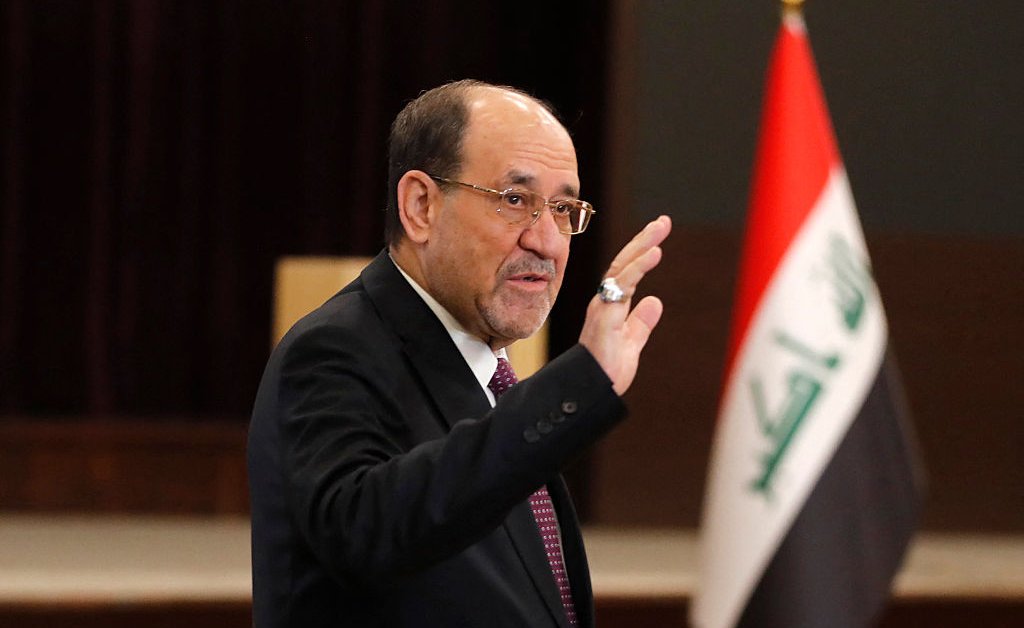
President Donald Trump threatened to end U.S. support for Iraq if Nouri Kamal al-Maliki returns to power, the latest intervention in another country’s politics by an Administration that campaigned on extricating the U.S. from foreign entanglements.
“Last time Maliki was in power, the Country descended into poverty and total chaos. That should not be allowed to happen again,” Trump posted on Truth Social on Tuesday. “Because of his insane policies and ideologies, if elected, the United States of America will no longer help Iraq and, if we are not there to help, Iraq has ZERO chance of Success, Prosperity, or Freedom. MAKE IRAQ GREAT AGAIN!”
Al-Maliki was nominated to be Prime Minister by the largest Shia Muslim bloc in the Iraqi parliament on Saturday. Mohammed Shia al-Sudani, the country’s outgoing Prime Minister, suspended his bid for a second term in office earlier this month, clearing the field for al-Maliki to step into the role. Al-Sudani’s bloc won the largest share of seats in the country’s parliamentary elections last November but fell short of a governing majority. The Coordination Framework, a coalition of Shiite parties with close ties to Iran and which acts as the kingmaker for the premiership, reportedly could not choose between the two candidates and left it to them to decide.
Trump’s threat puts Iraq in a bind, as it has long navigated a delicate balance between the U.S. and Iran—its two closest allies who have a tense relationship with each other. If Trump chose to cut U.S. support for Iraq, he could start with restricting the country’s access to its oil revenues, which are held at the New York Federal Reserve.
The warning comes after the U.S. has tried for months to curb Iranian influence in Iraq. U.S. Secretary of State Marco Rubio spoke with al-Sudani over the phone on Sunday with the view of “ensuring that Iraq can fully realize its potential as a force for stability, prosperity, and security in the Middle East.”
“A government controlled by Iran cannot successfully put Iraq’s own interests first,” the State Department readout of the call said.
Trump, who campaigned on an isolationist “America First” platform, has increasingly intervened in other countries’ affairs. The Trump Administration began the year with a raid on Venezuela, capturing the country’s leader Nicolas Maduro, asserting U.S. control over the country’s oil reserves, and pressing the new leadership to govern in line with Washington’s demands. Trump has also escalated economic pressure on allies, threatening Canada with 100% tariffs over its business dealings with China and hitting Europe with new tariffs before backing down amid resistance to his territorial ambitions in Greenland. Earlier this month, Trump also threatened to intervene in Iran in support of anti-regime protestors, just months after he bombed Iran’s nuclear facilities.
Who is Al-Maliki?
Al-Maliki was the first Prime Minister to hold office under Iraq’s new constitution in 2006 as a leader within the Shiite Islamic Dawa Party. Iraq is a Shia-majority country. At the time, al-Maliki was backed by the George W. Bush Administration.
He rose to prominence after decades in exile in Iran and Syria after fleeing Saddam Hussein’s crackdown on Shiite opposition groups in the late 1970s. He returned to Iraq after the 2003 U.S. invasion toppled Saddam, served as a key negotiator for the Shiite alliance in the drafting of the country’s constitution, and positioned himself as capable of restoring order in a country fractured by insurgency.
When al-Maliki came to power in 2006, Iraq was in the midst of sectarian violence between Sunni and Shiite factions, including the bombing of al-Askari Mosque months before he assumed premiership. During his first term from 2006 to 2010, the U.S. deployed around 30,000 additional troops as part of a “surge” aimed at suppressing insurgent violence and stabilizing Baghdad. Al-Maliki, alongside the U.S., supported the Sunni tribal “Anbar Awakening,” a grassroots movement in which local leaders turned against al-Qaeda in Iraq. Those efforts, combined with security operations against both Sunni insurgents and Shiite militias, weakened al-Qaeda between 2007 and 2009, allowing al-Maliki to consolidate power.
Critics, including the U.S., blamed al-Maliki for eroding the post-2003 promise of inclusive politics. Al-Maliki carried out sectarian policies under the banner of de-Baathification, which was originally designed to sideline Saddam loyalists. Al-Maliki’s government increasingly excluded Sunni Arabs from political life, including barring nine parties and over 450 candidates from running in the 2010 parliamentary elections, overseeing the arrests of prominent Sunni politicians by security forces, and suppressing peaceful protests. Critics have also accused him of entrenching corruption, weakening public services, and expanding his control over the judiciary and security forces.
By 2014, years of corruption and sectarian politics had hollowed out the army, contributing to its rapid collapse when the Islamic State (ISIS), an extremist Sunni jihadi group, seized large swaths of northern Iraq. Al-Maliki ultimately stepped down in the face of intense pressure from Iraqi politicians and the U.S.
Now, 75, al-Maliki has remained a key power broker within the Coordination Framework, leads the State of Law Coalition, a Shiite political alliance, and has maintained close ties with Tehran-backed factions.
How is the U.S. pressuring Iraq?
Trump’s warning on Tuesday is the latest in a sustained pressure campaign to constrain Iranian influence in Iraq—with the country’s oil as a key point of leverage. Iraq’s oil export revenue has largely been held at the New York Federal Reserve Bank as part of arrangements put in place after the 2003 U.S. invasion.
The Trump Administration has threatened senior Iraqi politicians with sanctions on Iraq if Iran-backed armed groups are included in the next government, sources told Reuters last week. In a letter to Iraq, which an Iraqi source confirmed to Al Jazeera, U.S. representatives said that while choosing the Prime Minister is up to Iraq, “the United States will make its own sovereign decisions regarding the next government in line with American interests.”
Iran has ties to al-Maliki, but also across Iraq’s political spectrum, including with numerous Shiite parties, militia leaders, and senior officials. Iran has also long considered its neighbor an economic lifeline as it faces U.S. sanctions. For years, Washington has tried to restrict Iran’s use of Iraq’s banking system to skirt sanctions, although it has never targeted the flow from the New York Fed to Iraq.
Rep. Joe Wilson (R, S.C.) expounded on the Trump Administration’s demands on X shortly after Trump’s post.
“Under President Donald J Trump the position of the United States is clear and unequivocal,” Wilson posted on Tuesday. Wilson said any Iraq government would need to “place Iraq and its people first” by fully disarming and dismantling all Iran-linked militia groups within 12 months, and remove all Iranian advisers, operatives and agents from the country.
“Iranian influence in Iraq will no longer be tolerated,” he said. “The era in which outside actors imposed prime ministers on Iraq is over.”
Uncategorized,Donald Trump,News Desk,overnightIraq,Donald Trump,News Desk,overnight#Trump #Threatens #Iraq #Leadership #Change1769591266