Warning: Spoilers ahead for the Season 1 finale of Wonder Man.
The final episode of Wonder Man’s first season opens with a childhood memory. A young Simon Williams sits with his father outside a burger joint, soda and fries between them. They’ve just left a screening of the original ‘80s Wonder Man film. They rave about the character’s costume—his ruby-lensed glasses, that jetpack—before the conversation turns more personal. Simon’s father says he was good in his school production of Twelfth Night—not in the reflexive way an adult often praises a child’s participation, but genuinely good. He has a gift, and if he works hard, there’s no limit to what he might do.
In the present, Simon (now played by Yahya Abdul-Mateen II) pounds his car’s steering wheel, driving away from wreckage. The new Wonder Man film set lies in ruins, brought down in the penultimate episode after Simon’s powers erupted once he discovered Trevor Slattery (Ben Kingsley) was gathering information on him for the Department of Damage Control all along. Government SUVs converge on the studio lot; manhunt protocols activate.
Wonder Man spent much of its first season examining what it costs to possess power you can’t fully control while presenting the world with a version of yourself it finds acceptable. For Simon, a struggling actor who hides his ability to manipulate ionic energy, and Trevor, a performer coerced into working for the government, the question was never whether they could survive. By the finale, they’ve both learned how. The harder question—the one the episode answers in its final moments—is what kind of person you become when survival stops being enough.
Simon goes home. He calls his mother the next day, asks about a bothersome branch in her yard; before hanging up, he tells her he loves her. Night settles. Simon drinks. His phone rings.
A friend’s sacrifice and public confession

Trevor doesn’t defend himself or ask for forgiveness on the call. He’s spent his life squandering opportunities, he tells Simon, and he won’t let Simon lose the only one he’s been given. This movie is Simon’s shot. “Live life to the fullest,” Trevor advises. “Savor every moment.” He hangs up.
Moments later, Trevor’s recorded confession appears on news broadcasts nationwide. He claims responsibility for the set explosion, the statement tipping into one final performance. He invokes the late CIA director Allen Dulles and Cold War fears of Soviet mind control, arguing that Hollywood has long functioned as a tool for shaping the public’s perception. The explosion, Trevor says, was an act of resistance carried out at the “heart of the indoctrination factory.”
His speech widens Wonder Man’s lens. Delivered with an ease that flirts with comedy, it can be taken as humor punctuating drama. But it is also the moment the series quietly clarifies its deeper concern: institutional control of the public narrative. When institutions decide what power means, individuals can lose control of their own story—and that loss carries consequences.
The Department of Damage Control arrests Trevor. Agent Cleary (Arian Moayed) makes the terms clear: Trevor can take the fall, but Simon remains under watch.

Returning to work, attending the big premiere
Morning comes. Von Kovak (Zlatko Buric), the volatile director who cast Simon as Wonder Man, offers Simon some useful guidance: everything he now feels—grief, anger, betrayal—that’s what art is made of. “Use it,” Kovak urges. “Let the misery drive the bus.” He was born to play this role, he’s reminded.
Then the props supervisor approaches with the original glasses worn by the actor who starred in the ‘80s Wonder Man film Simon watched with his father. Simon is quietly stunned. He puts on the costume; he stands before the camera. The scene he films sees Wonder Man betrayed by Barnaby, the role Trevor would have played, now performed by someone else. Here, Simon acts opposite a tennis ball. Someone reads Barnaby’s lines off-camera. He does the work.
At the premiere, Simon watches the finished film with his family. His mother marvels—”I can’t believe that’s my son up there”—as brother Eric (Demetrius Grosse), once skeptical of Simon’s career but now moved by his onscreen performance, quietly wipes away tears. They embrace afterwards. “You were really good. I’m excited for you,” Eric says. “Just hope that you don’t forget us little people in Pacoima now that you’re a big shot.” He wishes their father had been there to see it. In the end, Simon earned Eric’s approval not from fame but from finally seeing Simon’s talent fully realized.
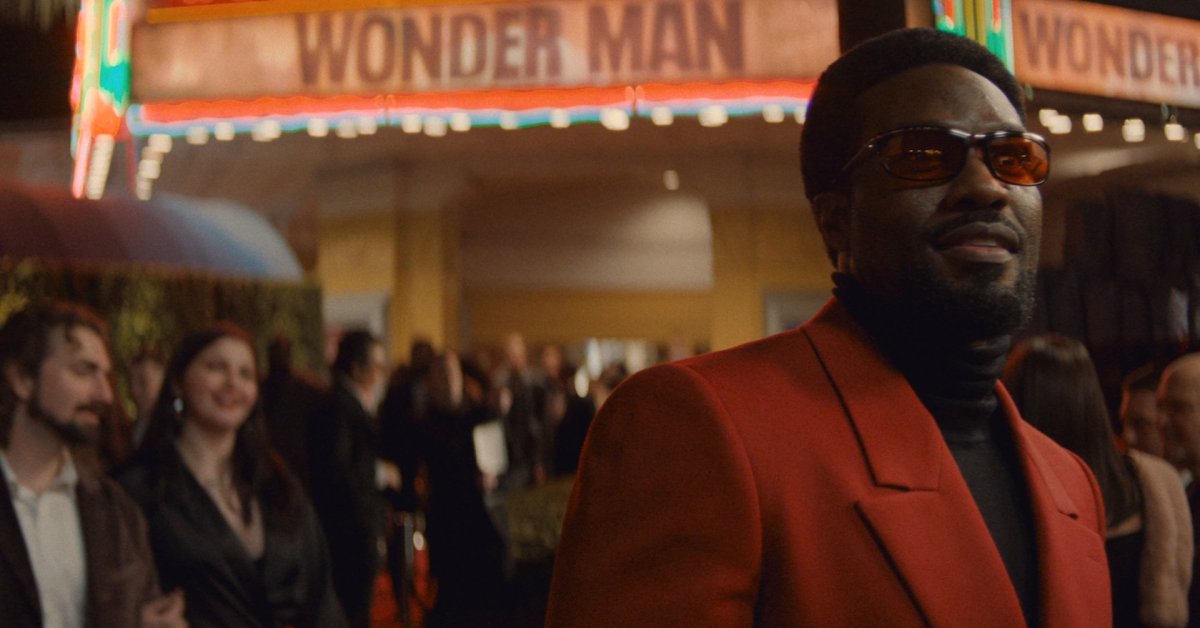
Outside the theater, fans chant Wonder Man’s name. Flashbulbs go off. His agent (X Mayo) finds him, exhilarated. Trevor is gone, and can’t be found, she says. But Simon now has his pick of projects. Hollywood is ready to move forward with its newest star; Simon isn’t.
Shadowing Chuck Eastman
Instead, he approaches a man named Chuck Eastman with an unusual request. He wants to shadow him for an upcoming project and observe the quiet rhythms of his everyday life: grocery runs, karaoke nights, doctor’s appointments.
Chuck agrees, bemused. At dinner with Chuck’s family, Simon eats pot roast and admits the situation is strange even to him. His son corrects his mother when she claims this is what she normally makes. Chuck’s daughter Lucy asks if he knows Dua Lipa. The scene is warm, slightly awkward—ordinary in the way Simon is learning to value, now that life is transformed by success. For someone who spent years hiding what he was, learning to truly see other people may be the more important superpower.
Chuck’s life comes into focus over a heart-to-heart as he works on his car: medical bills from his daughter’s illness, depression triggered by work, stress dreams, exhaustion. The next day, Chuck takes Simon running, huffing and puffing, and jokes that if Simon’s going to play him, he’d better make Chuck a terrible runner.
Then he tells Simon he’s managed to get him cleared to visit his workplace. Simon will pose as a new trainee named Alfonso. “Now you’ll finally see what keeps me up at night,” Chuck says. They drive into the desert, dust trailing Chuck’s pickup. The facility that emerges is the Department of Damage Control.
The rescue that changes everything

Inside, agents discuss ionic scans from the Wonder Man set explosion. If Simon can harness ionic energy, he’s either an extraordinary threat or an extraordinary asset. Simon moves through corridors unrecognized until he stops in front of a cell.
Trevor sits alone inside. He looks up when someone stops by. It’s Simon, the actor he both helped and monitored, the friend he betrayed. Trevor tears up.
“How’d the movie come out?” he asks quietly.
“It would have been better with you as Barnaby,” Simon replies.
Trevor wonders aloud who replaced him in the role. Robert De Niro? Pierce Brosnan? Antonio Banderas? “We always get mistaken for each other,” he jokes.
Wielding his powers, Simon tears the cell bars away. Trevor protests the corridors ahead are filled with guards, motion sensors, and biometric security—but Simon has figured another way out. He exhales. Energy gathers. He could bring the entire facility down if he wanted to. Instead, he chooses the smallest gesture that will work.
Trevor’s eyes widen as particles swirl around them both. Simon grabs him. They rise hundreds of yards into the sky. Harry Nilsson’s “Everybody’s Talkin’” plays. The camera holds on them mid-ascent.
Wonder Man never promised Simon would become a traditional superhero. It offered a more uncertain premise: that a gifted actor with power he can’t fully control might figure out what matters more than survival, more than success, more than secrets he never asked to be responsible for.
Trevor saw Simon clearly enough to betray him. Then he saw him clearly enough to take the fall. Simon’s family knows what he can do now; his brother finally understands who he is. And in a government facility in the desert, Simon made a life choice that had nothing to do with career or consequence, and everything to do with friendship.The show’s finale doesn’t end neatly: the Department of Damage Control is mobilizing. Whatever happens next in Wonder Man will prove complicated, probably dangerous. But Simon has stopped trying to stay small and safe. In embracing his full self, he’s also chosen what, and who, to hold onto. That might be the only kind of power that actually matters—the kind that lifts you both into an uncertain sky, still rising.
Uncategorized,culturepod,Explainer,freelanceTelevision,culturepod,Explainer,freelance#Breaking #Cathartic #Finale #Marvels #ltigtWonder #Manltigt1769525266