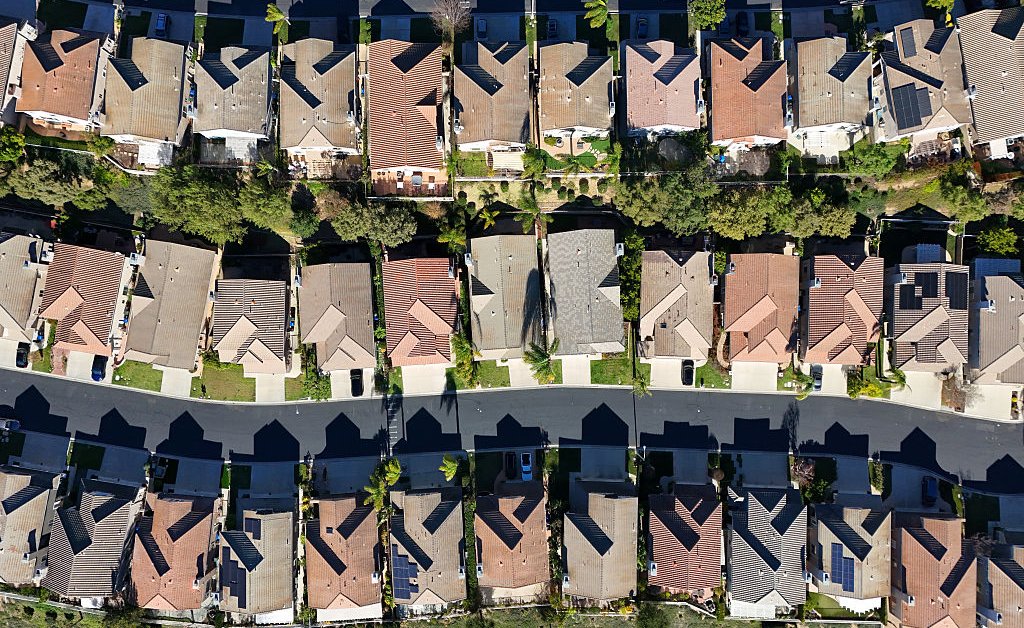
President Donald Trump has signed an Executive Order that his Administration contends will help lower housing prices and stoke affordability by placing restrictions on big investors’ home purchases. But experts say that its impact for homebuyers and the broader market will be minor.
The order signed by Trump on Tuesday directs his Administration to work to bar large institutional investors from buying single-family homes in an effort “to make homeownership affordable again after years of Wall Street crowding out first-time buyers and young families,” in the White House’s words.
“Hardworking young families cannot effectively compete for starter homes with Wall Street firms and their vast resources,” the order reads. “Neighborhoods and communities once controlled by middle-class American families are now run by faraway corporate interests … My Administration will take decisive action to stop Wall Street from treating America’s neighborhoods like a trading floor and empower American families to own their homes.”
The order lays out several broad steps for the Administration to take in the coming weeks to review relevant policies and impose restrictions. The specifics of how it might be implemented are not yet clear, however, including how the terms “large institutional investor” and “single-family home” will be defined—which the order gives Treasury Secretary Scott Bessent 30 days to determine.
Experts tell TIME that they expect the move to have only a small effect, saying that its scope is limited and it doesn’t address the issues most responsible for high housing prices.
“This executive order appears to be fairly benign in practical terms,” says Tobias Peter, a co-director at the American Enterprise Institute Housing Center. “It gives the impression that the Administration is taking action against these institutional investors, but the actual channels that it targets are likely limited.”
Here’s what to know about the order, and how it could affect homebuyers and renters.
What does Trump’s order do?
The order directs agencies to promote home sales to individual buyers and restrict federal programs from enabling big investors to acquire single-family homes by “approving, insuring, guaranteeing, securitizing, or facilitating” such sales.
The order also instructs the Treasury Secretary to consider revising rules and guidance related to large institutional investors acquiring single-family homes, and directs the Attorney General and Federal Trade Commission to review such investors’ acquisitions in the single-family home rental market for “anti-competitive effects” and prioritize their enforcement of antitrust laws to target some of those practices.
Within the White House itself, it instructs several officials to develop legislative recommendations to codify the order’s goals.
What will the order mean for housing prices?
Despite the Administration’s claims about Wall Street investors “crowding out families” and controlling neighborhoods and communities, large institutional investors don’t actually dominate the single-family housing market, Peter tells TIME.
His research has shown that roughly 1% of the entire single-family housing stock is owned by big investors, about 11% by smaller mom-and-pop shop investors, and 87% by individuals. Peter defines “large institutional investors” as those acquiring hundreds of homes at a time.
Another tally, from a 2023 Urban Institute report, estimated that institutional investors owned about 3.8% of all single-family rental homes nationally by June 2022.
Peter also says that “large single family rental investors generally do not heavily rely on government backing,” and that institutional investors’ home acquisitions haven’t been shown to drastically increase prices for individual buyers.
On the contrary, Peter notes that large investors might actually save homebuyers money by refurbishing fixer-uppers whose renovation costs would have otherwise been out of reach for them, performing what he described as “a vital function by fixing up dilapidated homes” and returning them to the market.
“Since January 2012 in the largest 150 metros, we absolutely found no correlation between share of institutional investor owned homes out of the total stock in the metro to the home price appreciation,” Peter says. “It’s unlikely that they’re going to be moving the needle on housing affordability.”
Marc Norman, the associate dean of the Schack Institute of Real Estate at New York University, also says that rising prices should not be attributed to a narrative of institutional investors’ dominance over the housing market.
“It’s based on a misconception,” he says about the Executive Order. “Housing prices are going up because of supply constraints … supply and demand is always going to be the driver.”
Norman references falling prices in Sun Belt markets, like those in Austin and Nashville, after supply booms following the COVID-19 pandemic. He stresses that building more homes would have the biggest impact on lowering pricing, but that the Trump Administration’s tariffs have increased construction costs for materials like lumber and steel and, ultimately, the prices of many homes.
“If this executive order meaningfully limits investor activity, some first-time buyers could face slightly less competition—especially at the lower end of the market where investors are most active. But that doesn’t solve the core affordability problem, which is that there simply aren’t enough homes for sale,” Daryl Fairweather, the chief economist at the real estate brokerage firm Redfin, tells TIME in a statement.
She notes that Wall Street firms tend to be active in specific neighborhoods, rather than across entire metropolitan areas. High mortgage rates and years of underbuilding, she adds, are unaddressed but persistent contributors to rising prices.
“In the short term, we might see modest relief in a handful of markets, but unless this policy is paired with measures that increase housing supply, its impact on prices and affordability will likely be limited. The risk is that it creates the perception of action without addressing the structural issues that make housing expensive in the first place,” she says.
Zillow found in an analysis last summer that there was a national housing shortage of over 4.7 million homes. Addressing this shortage is the antidote to rising prices, Jenny Schuetz, vice president of infrastructure for housing at the philanthropic think-tank Arnold Ventures, says in a statement to TIME.
“Proposals that do not address the national shortage of around 4 million homes will not meaningfully impact America’s housing affordability challenges. The good news is that state and local governments across the country are increasingly taking creative steps to encourage affordability by reducing regulatory barriers and stimulating innovation to speed up homebuilding,” she says.
Peter says that if Trump’s order is implemented and large investors’ housing acquisitions are restricted, the supply shortage could still be remedied by large investors who choose to rent their properties, as opposed to developing homes for purchase.
“One positive about the Executive Order is that it leaves out built-to-rent development, so where the investor is partnering directly with the home builder to build large scale communities,” he explains. “From a supply perspective, that’s probably positive, because these large institutional investors, they are really the only ones that can do this at scale.”
Beyond its more direct implications for housing prices, Norman notes that the order may also affect the stocks of large real estate investment companies.
“It’s definitely going to change the price of the stocks of the big players that are in that market, just because they just haven’t had constraints on them before,” he says, adding that Real Estate Investment Trust (REIT) shares held up in single-family properties could lose value.
Uncategorized,News DeskTrump Administration,News Desk#Trump #Moving #Bar #Wall #Street #Firms #Buying #SingleFamily #Homes #Heres #Affordability1769045256