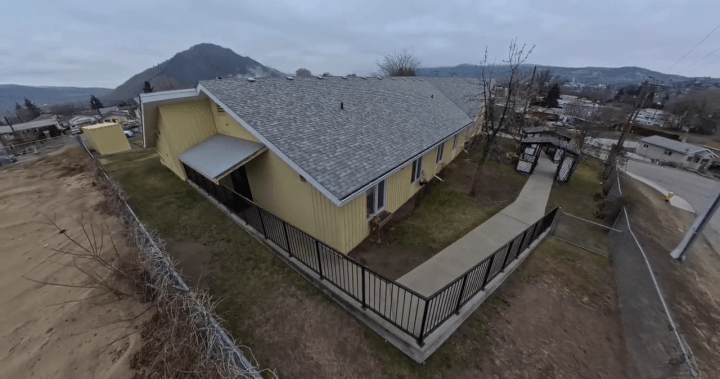
A property in Kamloops, B.C., has become the focal point of a controversial law governing First Nations archaeology and another debate over property rights in the province.

A private landowner was excavating their property in June to make a community garden for seniors when they unearthed two human skulls.
“I can’t tell you anything more about it because the RCMP was called, the coroner’s office was called, the Tk’emlúps First Nation was called,” lawyer Christine Elliott, who represents the landowner, told Global News.
“So we then slide into two and a half months of silence, where I can’t get anyone to speak to me. The RCMP tell me I need to do a Freedom of Information search on my client’s private property land, the coroner’s office won’t respond to me at all, the Heritage Conservation Branch won’t respond to any of the emails that I send, and so I said to my client ‘Well, time to get an archeologist’.”
After the landowner reported the discovery, the Tk’emlúps te Secwépemc First Nation declared the property a “sacred site.”

Get breaking National news
For news impacting Canada and around the world, sign up for breaking news alerts delivered directly to you when they happen.
In a press release, the Tk’emlúps te Secwépemc said that “The site is protected under the United Nations Declaration on the Rights of Indigenous Peoples and the BC Heritage Conservation Act. Any alteration or disturbance to the sacred site is illegal and punishable under provincial law.”
As a result, Elliott said the owners are facing more than $100,000 in legal and archeological costs, including an $80,000 charge from the First Nation for a smudging ceremony, repatriation of bones, an archeological dig and a culturally-appropriate security person to guard the site.
Elliott said she did find an archaeologist willing to take a look at the site.
“His report…. concludes that this is not an archaeological site,” she said. “There are no burn marks on rocks, there are no other obvious accoutrements of an Aboriginal site, but there is about a metre and a half of sand filled with bits of broken-up concrete, pipes and other stuff that looks like it came off some other construction site on there. These skulls were located in that fill.”


Elliott said they do not know when the skulls were transferred into that fill, but according to the archaeologist’s report, the skulls were dumped sometime prior to 2004.

She said, at this stage, she does not have a solution to her client’s case.
“My client wants everyone to know in the province that they, too, could be subject to all of this; it could happen to anyone at any time,” Elliott added.
The property owner has now abandoned all plans for the site, saying the land is effectively unusable and unsellable and is stuck in legal limbo.
The B.C. government did not respond to questions from Global News. The Tk’emlúps te Secwépemc First Nation did respond to an email asking for more information before Kúkpi7 Rosanne Casimir would respond publicly.
© 2026 Global News, a division of Corus Entertainment Inc.
Perspectives,Politics,Kamloops,Tk’emlúps te SecwepemcTk'emlúps te Secwepemc, Kamloops, Perspectives, Politics#Discovery #skulls #Kamloops #property #leads #debate #B.C #property #rights1768891474