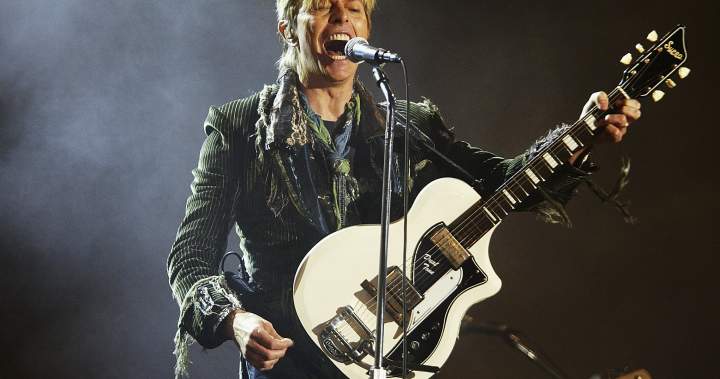
On Jan. 10, 2016, David Bowie, suffering from end-stage liver cancer, lay down for a nap. He never woke up. Have you noticed how things haven’t been the same since?

If you feel this way, you’re not alone. Actor Gary Oldham, a Bowie friend to the end, asserts that “the world has gone to s—.” Charlie Angus, Canada’s punk rock MP and now part of the Meidas Touch Network, articulates his David Bowie theory this way: “David Bowie went to the angels, and the world has been in hell ever since.”
Esquire picked up on the situation just five years after Bowie’s death.
There is no empirical research or factual data that I know of that can prove this, but anecdotally, it sure feels like it.
On June 23, 2016, the UK voted to leave the EU in the Brexit referendum (fuelled by the corrupt Cambridge Analytica scandal), a decision that proved to be mostly disastrous for everyone in Europe. They followed through on Jan 31, 2020. In November 2016, Donald Trump was elected to his first term, which, of course, ended with the U.S. Capitol riot on Jan. 6, 2021.
I can go on: COVID-19, Putin’s Russia invades Ukraine, the Gaza/Israel conflict, Syria, Sudan, Yemen, Venezuela, more mass shootings, accelerating climate change, the end of Roe v. Wade, George Floyd, the rise of AI in many not-so-beneficial ways, and a second, even more chaotic and despotic Trump administration.
I’ll toss this in, too. For many, Bowie’s death marked the beginning of a cascade of passings of musical heroes. The opening acts were the deaths of Scott Weiland of Stone Temple Pilots and Motorhead’s Ian (Lemmy) Kilmister in December 2015, but the avalanche really began with Bowie.
Glenn Frey of The Eagles, two members of The Jefferson Airplane (on the same day), Maurice White of Earth, Wind & Fire, Beatles producer George Martin, Keith Emerson and Greg Lake of Emerson, Lake & Palmer, George Michael, and, of course, Prince, all followed over the next 12 months.

Get daily National news
Get the day’s top news, political, economic, and current affairs headlines, delivered to your inbox once a day.
I’m sure it’s all a coincidence and the natural order of things, but it’s no exaggeration to say that since Bowie died at the age of 69, we’ve transitioned into a completely different world. Yet one thing remains: David Bowie still matters. In fact, he may matter more than ever before.
David Bowie performs live on stage at Earls Court Arena on May 12, 1973, during the Ziggy Stardust tour. Photo: Gijsbert Hanekroot / Redferns.
Gijsbert Hanekroot / Redferns
In the last 10 years, we’ve had a chance to examine Bowie’s legacy. We’d always known it was formidable, but time has a way of bringing things into even tighter focus, especially when music feels more disposable than ever.
I love the phrase “cultural architect” as it applies to Bowie. He was constantly reinventing himself, via music, fashion, and public personas. His influence extends to countless artists through multiple genres: glam, punk, pretty much everything New Wave and post-punk, pop, electronic music and music videos. More than anyone else, he shattered norms and was never afraid to rip it all up and start again, even if it meant turning his back on his greatest works.
This brings me to my personal Bowie disaster.
On Dec. 3, 1991, Bowie brought his new band, Tin Machine, to the Concert Hall — the old Masonic Temple —in Toronto. It’s a small venue with a capacity of around 1,200 people, so even though Tin Machine wasn’t exactly setting the world ablaze, the idea of being able to see Bowie in such a small place had the city buzzing.
Just before noon, I received a call at the radio station (then still known as CFNY, now 102.1 The Edge), asking if I’d be interested in interviewing Bowie that afternoon. What? Really? Absolutely! After my shift ended at 2 p.m., I jumped in the car and headed to the Concert Hall with my cassette machine in tow.


I was ushered into a large basement room with two folding metal chairs facing each other in the exact middle of this very Masonic rites-looking room. Trying not to fanboy my way into embarrassment, I put my cassette recorder on the floor and proceeded to get things ready. As I was finishing up, a hand was thrust in front of my face. When I looked up, I heard, “Hello. I’m David.”
The next 30 minutes were a blur. I had Bowie all to myself, and he was completely in the moment, looking me in the eye, gently directing the conversation (with me even noticing), and getting through all his key points. For that half hour, he made me feel like I was the only person on Earth that mattered. The amount of natural charisma he possessed could not be measured in human terms.
Meanwhile, I was trying to hold it together. The thought bubbles above my head scrolled by: “That’s David Bowie. He’s talking to me. He’s The Man Who Sold the World. That’s Ziggy Stardust. I’m having a conversation with Aladdin Sane, the Thin White Duke, and the Let’s Dance guy! Look! The two different eyes! The swoopy hairstyle! The charmingly crooked teeth! I have no idea what I’m saying and I don’t know what he’s saying, but I’ll hear it all later.”
When our time was up, he signed my Tin Machine CD, shook my hand and departed. I was floating — until I looked down at my cassette machine. I’d forgotten to unpause it. I had David Bowie to myself for half an hour, and nothing was recorded. You can imagine how well that went down back at the radio station.
Several years later, I managed to run into Bowie again during a radio station visit. I approached him. “David? A word, please.”
Once again, he gave me his full attention as I explained the incident with the tape machine, punctuating my story with, “I see. You don’t say? Well!”
When I was done, he put both hands on my shoulders, looked me in the eye, and said, “Well, that was stupid of you, wasn’t it?” And then he was gone, melted into the crowd.
I never had another chance to interview him, so those were his last words to me. I wish I’d had one more chance.
I have a three-part Ongoing History of New Music series on why Bowie still matters that is available as podcasts. Learn more here, here and here.

Entertainment,David Bowie,Death,InterviewDavid Bowie, Death, Interview, Entertainment#David #Bowie #died #years #flubbed #interview #haunts1768143671